Heat / Ingredients / Texture / Kitchen skills
From runny to thicker
How does a cooked-and-cooled cornstarch mixture compare with an unheated matching mixture?
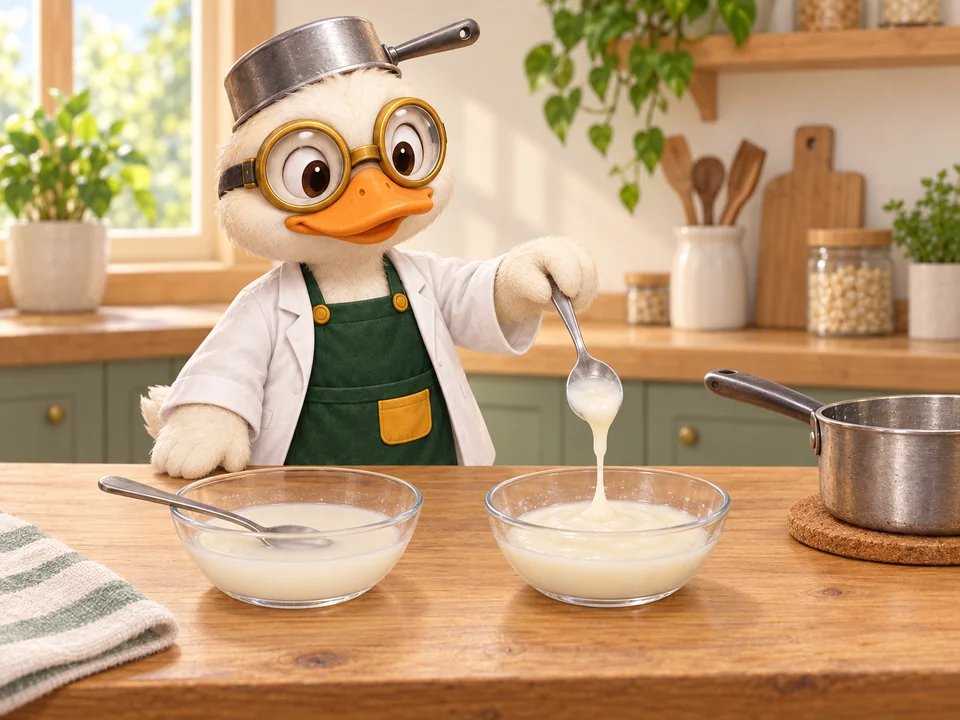
An adult heats one measured mixture while its partner stays unheated. Learners predict, observe from a safe position and compare cooled spoonfuls.
Proposed procedure; kitchen trial pending. Explore with an adult and follow the preparation and handling notes.
- Hands-on time
- 25 min
- Total time
- About 60 min
- Difficulty
- A little practice
- Participation
- Explore together
Before you investigate
A thoughtful setup.
Neither the heated nor the unheated sample is for tasting. Do not use the raw mixture as sensory play.
The adult’s part
- Operate the stove, stir continuously, handle steam and transfer the hot mixture.
- Check that the burner is off and determine when both bowl and sample are fully cool.
Tools & heat
- Use a suitable saucepan, heatproof bowls, dry mitts and a trivet.
- Keep the handle toward the back; no learner handling of hot equipment.
Ingredients & allergens
- Plain cornstarch and water only; no raw-flour substitution.
- Read the cornstarch package and check ingredient and cross-contact requirements.
- Cornstarch is not a guarantee of suitability for every household.
Prepare your space
- Keep the learner and notebook at a separate observation position.
- Keep clothing, paper and cords away from heat and contain cooled comparison spills on a tray.
- Keep children and pets at least 3 feet away from a hot stove.
Build the relevant habits
Review or print my preparation checklist
Checking this browser…
Discover
What you’ll learn.
- Describe starch thickening as a heat-and-water process.
- Compare samples at similar final temperatures.
- Recognize heating, stirring and evaporation as limits of a household comparison.
Change: An adult’s defined heating treatment versus leaving an equal mixture unheated.
Keep the same: 1 tablespoon of the same cornstarch and 1 US cup cold water per mixture · Initial ingredient temperature and measuring method · Matching bowls and equal teaspoon comparison portions · Similar room-temperature samples for the final comparison
My prediction
Try it
Follow your question.
Make two matching mixtures
Stir 1 tablespoon cornstarch with 1 US cup cold water in the Unheated bowl. The adult makes the same mixture in the saucepan. Describe both starting mixtures before any heat is applied.
Adult: apply the heating treatment
The adult heats the saucepan over medium heat, stirring continuously. Once the mixture is bubbling, continue stirring for 1 minute. Turn off the burner. The learner records the sequence of visible changes from the agreed place, without approaching the stove.
Care at this step: Adult alone manages heating and steam; stay with the pan.
Adult: transfer and allow full cooling
The adult moves the saucepan to the trivet and transfers the mixture to the labeled heatproof bowl. Leave it undisturbed in a protected place until fully cool. Keep the Unheated bowl nearby, away from the hot pan.
Care at this step: Adult transfer only; a timer does not establish safe-to-touch temperature.
Prepare a consistent comparison
After the adult confirms both samples and bowls are fully cool, stir each with its own spoon using five gentle strokes. Describe any settling, lumps or surface film before and after this stirring.
Care at this step: Begin learner handling only after the adult confirms full cooling.
Compare equal spoonfuls
Use matching teaspoons to lift equal spoonfuls. Tip each spoon at approximately the same angle over its own bowl for 5 seconds. Describe whether the sample runs, drips, falls in a lump or stays on the spoon. Repeat once in the same way; do not use your fingers to test the mixture.
Care at this step: Use spoons, not fingers or tasting, to compare flow.
Explain the difference and finish
Write a sentence linking your flow observation to the heating treatment. Add one limitation, such as evaporation or different stirring histories. Scrape the cooled mixtures into household waste, then wash bowls, pan, tools and hands.
Care at this step: Check the burner is off and discard cooled mixtures before washing.
Observe
Look a little closer.
- How did the saucepan mixture’s appearance change before bubbling and during the adult’s continued stirring?
- Did either mixture settle, form lumps or develop a surface film?
- How did equal cooled spoonfuls flow under the same tipping method?
- What parts of the treatment besides temperature were difficult to keep identical?
Different results are useful. Record what you see, rather than trying to match an expected answer.
My observations
Understand
What’s going on?
Cornstarch contains granules made from starch molecules. With enough water and heat, their structure changes and the mixture can thicken; this process is called gelatinization. The cooled result is not simply sugar-like dissolving. Our unheated partner shows how the same starting ingredients behave without the cooking treatment. The outcome still depends on the actual quantities, heat and stirring.
Use this in your kitchen
Starch thickening is used in sauces, gravies and fillings. A recipe specifies ingredients and cooking because a cold mixture and a cooked mixture do not necessarily behave the same way. This observation-only activity is not a sauce recipe, and its texture cannot tell you whether another food is cooked safely.
Go deeper
Heating starch in water alters the organization of its granules and the arrangement and dispersion of starch molecules. The resulting flow depends on concentration and treatment, and cooling can change it further. A spoon-flow description is useful evidence, but it is not a calibrated viscosity measurement. The word “gelatinization” describes starch behavior; it does not mean that gelatin was added.
Why results may differ
- Heating also changes stirring history and may evaporate water, so this is a cooking-treatment comparison rather than an isolated temperature measurement.
- A kitchen spoon test does not measure viscosity in scientific units.
- Cooling time depends on the bowl, room and sample; an estimate cannot certify safe handling.
- Different starches and instant products do not automatically follow this procedure.
Try again
One discovery.
Another question.
Repeat the same cornstarch comparison before changing anything. If an adult later compares another starch, use a separately reviewed procedure for that ingredient rather than assuming identical heating will suit it.
My conclusion and next question
Finish thoughtfully
Clean up
- Adult checks the stove and hot equipment, then washes cooled utensils and surfaces.
- Wash hands after the activity.
Dispose of the samples
- Scrape the cooled thick mixtures into household waste rather than pouring a mass of paste into the drain.
- Do not save either sample for food or play.
For parents & educators
Learning objectives
- Describe the before, heated and cooled states separately.
- Connect observed flow with a defined cooking treatment.
- Identify a confounding difference and a measurement limitation.
Prepare & make space
Read the complete sequence before starting. Arrange adult heat management and a separate learner station. Reserve enough time for full cooling; total time may be longer than an hour.
The adult’s part
Own every heat, steam, transfer and hot-equipment task. Stay with the pan, keep its handle back and decide when the sample and bowl can be handled.
Talk about it
- Why wait until both samples are at similar temperatures?
- What did stirring change?
- Why is “slower from the spoon” more defensible than an invented viscosity number?
A simple way to join in
Learners can predict, watch the adult demonstration and dictate flow descriptions. Skip hands-on spoon handling when adult handling is more suitable.
Take it further
Make a three-panel diagram showing before heating, after cooking and after cooling. Label observed features separately from a simplified granule model.
Explore as a group
Use one adult demonstration for the group. Let learners compare cooled spoonfuls in turns with clean dedicated tools; no tasting station.
Clean up
The adult checks that the burner is off and the pan has cooled. Scrape thick mixtures into household waste before washing; wipe spills and wash hands.
Behind the explanation
- NDSU Extension 4-H: Baking 4, page 35 (Montana State University host) ↗
The starch exercise uses 1 tablespoon cornstarch with 1 cup cold water, continuous stirring over medium heat, bubbling for 1 minute, then cooling. This adaptation compares it with an unheated matching mixture.
- University of Nebraska–Lincoln: Gelatinization and Solubility of Corn Starch during Heating in Excess Water ↗
Explains gelatinization as structural changes and dispersion of starch molecules during heating in abundant water; it is more complex than sugar dissolving.
- U.S. Fire Administration: Cooking Fire Safety ↗
Stay with cooking, keep combustibles away from the stove and turn pan handles toward the back.
- FDA: Handling Flour Safely — What You Need to Know ↗
Raw flour is not a ready-to-eat food. Do not taste raw dough or use raw-flour dough for children’s play; this activity does not use flour.
- FDA: Have Food Allergies? Read the Label ↗
Ingredient labels and cross-contact matter; absence of a voluntary precautionary statement is not a guarantee that an allergen is absent.
Activity exp-starch · Content version 1 · Sources checked 2026-09-25 · Proposed procedure; kitchen trial pending