Ingredients / Texture / Changes
Fruit and the wobbly gel
How does gelatin setting compare with fresh pineapple, canned pineapple or no fruit?
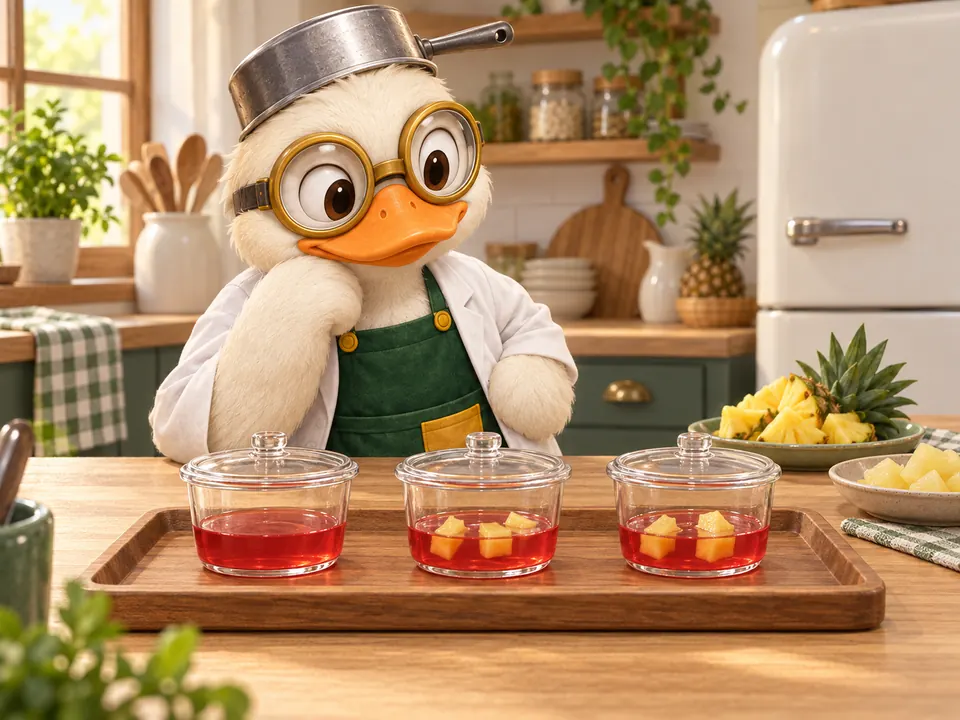
Set up three small samples from one batch with adult help. After refrigeration, compare their movement and explain what a plain control can tell you.
Proposed procedure; kitchen trial pending. Explore with an adult and follow the preparation and handling notes.
- Hands-on time
- 25 min
- Total time
- About 265 min
- Difficulty
- A little practice
- Participation
- Explore together
Before you investigate
A thoughtful setup.
Keep every investigation sample separate from food to be served. Do not taste these samples.
The adult’s part
- The adult checks ingredient labels, cuts fresh fruit, opens the can, heats water, dissolves the gelatin and portions the warm mixture.
- The adult checks that containers are rated for the temperatures and refrigerator use required, and carries the tray.
Tools & heat
- Use matching shallow heat-safe cups on a stable tray. A drinking glass of unknown heat resistance is unsuitable.
- Keep hot liquid away from table edges; use dry protective mitts where needed. Use oven mitts for hot cookware. Open heated food containers slowly with the face away from escaping steam, and keep hot food and drinks back from counter edges.
Ingredients & allergens
- Rinse fruits and vegetables under running water before cutting or peeling. Do not use soap, detergent or bleach on produce.
- Use regular animal-gelatin dessert mix with the specified package preparation. Agar and other setting agents answer a different question.
- Keep fresh pineapple separate from canned pineapple until each enters its own labeled sample.
- Read ingredient information every time, even for a familiar product. A “Contains” statement identifies major allergens used as ingredients if that statement is present; not every product has one.
- Check the gelatin dessert and canned-fruit labels and dietary suitability. Pineapple itself may cause allergy; gelatin is animal-derived.
Prepare your space
- Scrub hands with soap and running water for at least 20 seconds, including backs, between fingers and under nails. Rinse and dry with a clean towel.
- Clear refrigerator space before starting. Cover and label the samples so they cannot be confused with dessert.
- Keep the refrigerator at 40°F (4°C) or below; check with an appliance thermometer.
- Refrigerate perishable food within 2 hours. If exposed to temperatures above 90°F (32°C), refrigerate within 1 hour. Discard perishables left out beyond the applicable limit.
Review or print my preparation checklist
Checking this browser…
Discover
What you’ll learn.
- Use a plain control when comparing two fruit preparations.
- Connect gelatin’s protein network with an enzyme that can cut proteins.
- Separate a product comparison from proof about one isolated cause.
Change: Fruit condition: no fruit, 10 g fresh pineapple, or 10 g drained canned pineapple.
Keep the same: One prepared gelatin batch and 60 mL in each comparison cup · Matched fresh/canned fruit mass and similar piece size · Matching cups, covering, shelf location and chilling duration · Five gentle stirs and the same brief tilt observation for each
My prediction
Try it
Follow your question.
Label and predict
Write the product, the fruit preparations and your prediction. Adult places 10 g fresh pineapple in Fresh and 10 g drained canned pineapple in Canned, keeping Plain empty. Record approximate piece size and any mismatch.
Care at this step: Fruit cutting and can opening are adult-only preparation.
Adult prepares one batch
The adult follows the matching packet’s standard directions: dissolve its whole contents in 1 US cup boiling water, stirring for two minutes, then mix in 1 US cup cold water. Keep learners clear of hot liquid. Do not change the water amounts to force a firmer result.
Care at this step: The adult handles boiling water and the warm mixture throughout.
Portion equally and chill
Adult immediately measures 60 mL of the prepared liquid into each comparison cup. Give each five gentle stirs with its own spoon, including Plain. Cover, label and refrigerate the three together promptly. Put unused mixture in a separate labeled container and refrigerate it too; it is outside the comparison. Record when the tray entered the refrigerator.
Care at this step: The adult portions and covers samples, then refrigerates them promptly.
Compare after four hours
After four hours of refrigeration, an adult brings out the covered tray for a brief comparison. View each cup from the side, then tip it slightly and return it upright, one at a time without inverting it. Describe flowing liquid, soft movement, wobble or a shape that holds. If Plain has not set, record that the setting comparison is inconclusive; do not treat the other cups as proof.
Care at this step: Keep lids on during the comparison; inspect briefly and discard, rather than leaving samples on display.
Check your explanation
Compare the fruit cups with Plain before comparing them with each other. State the result with its actual chilling time. Consider both the protein-cutting explanation and limitations such as different fruit products, piece sizes or incomplete setting. Do not invent a firmness measurement from a visual description.
Close the investigation
Draw the three cups and add a short evidence statement. Keep observations distinct from the explanation about enzymes. Discard the investigation mixtures, including the unused labeled batch, and follow the cleanup instructions.
Observe
Look a little closer.
- What products, fruit masses and approximate piece sizes were used?
- How long did the samples actually chill together?
- Did Plain hold a shape at the observation time?
- How did each covered sample move during the same slight tilt?
Different results are useful. Record what you see, rather than trying to match an expected answer.
My observations
Understand
What’s going on?
Gelatin is made of protein chains that can form a water-holding network as the mixture cools. Fresh pineapple contains bromelain, an enzyme that can cut proteins and interfere with that network. Heat processing of canned pineapple can reduce this enzyme activity. The plain cup checks whether the gelatin preparation could set without added fruit.
Use this in your kitchen
Fresh and canned fruit may behave differently in a gelatin dessert. Choose a tested recipe that specifies the fruit preparation and setting agent. Agar is not gelatin and cannot be substituted here while claiming the same protein-enzyme test.
Go deeper
An enzyme speeds a particular kind of chemical change; it does not decide what the cook wants. This comparison does not measure bromelain concentration or independently isolate heat treatment. Fresh and canned fruit can also differ in acidity, sugar, cultivar and storage, so the result is evidence consistent with a mechanism rather than a complete proof of it.
Why results may differ
- One cup per condition cannot establish repeatability.
- Fruit products and piece sizes may differ despite matching their mass.
- If the plain control fails to set, preparation or chilling may be responsible.
- A visual tilt comparison is not a calibrated gel-strength measurement.
Try again
One discovery.
Another question.
An adult can repeat the complete three-cup comparison on another day with the same products and recorded method. Keep both sets, especially if one does not match the predicted pattern.
My conclusion and next question
Finish thoughtfully
Clean up
- Adult checks that tools and jug have cooled, then washes them and wipes the fruit-preparation area.
Dispose of the samples
- Discard all investigation cups and the separately labeled unused batch after the final observation. Scrape set gel and fruit into household food waste/trash under local guidance; do not push solid gel down a drain.
For parents & educators
Learning objectives
- Explain why a no-fruit control matters.
- Distinguish a protein gel from a generic solid.
- Use measured conditions and qualified explanations.
Prepare & make space
This proposed setup has not had a QuackPot kitchen trial. Check the specified packet, 60 mL portions, fruit amounts, cup geometry and four-hour observation plan. Record actual results and mixture and refrigerator conditions.
The adult’s part
Perform all cutting and hot-liquid preparation, confirm container suitability and manage refrigeration and disposal.
Talk about it
- What would an unset plain cup change about your conclusion?
- Why is canned versus fresh not a test of heat alone?
- What observation supports your explanation, and what remains unknown?
A simple way to join in
Adult handles setup; learners draw the three labeled cups and describe their movement with words or gestures.
Take it further
Repeat the same batch plan with a second cup of each condition to explore agreement among replicates; keep the comparison quantities unchanged.
Explore as a group
Assign prediction reader, label checker, recorder and observation artist. Only the adult handles heating and sample transport.
Clean up
Adult disposes of samples, checks equipment has cooled, then washes tools and surfaces.
Behind the explanation
- University of Georgia Extension: Tropical Fruit Gelatin Lab ↗
Compares gelatin with fresh and processed pineapple and a plain control; explains protein-cutting bromelain and heating.
- Kraft Heinz: Jell-O Strawberry Gelatin Dessert Mix, 3 oz ↗
The standard preparation uses a cup each of boiling and cold water, two minutes of stirring, and four hours of refrigeration or until firm.
- FDA: Selecting and Serving Produce Safely ↗
Supports clean preparation and rinsing produce under running water before cutting, without soap.
- FoodSafety.gov: Four Steps to Food Safety ↗
Supports clean handling, refrigeration and limits on unrefrigerated time, represented by the lab’s shared safety rules.
- FDA: Have Food Allergies? Read the Label ↗
Supports checking complete ingredient labels and considering cross-contact.
Activity exp-gelatin · Content version 1 · Sources checked 2026-09-25 · Proposed procedure; kitchen trial pending