Ingredients / Kitchen skills
The color-changing cabbage
How does the same purple cabbage liquid respond to three food-based test liquids?
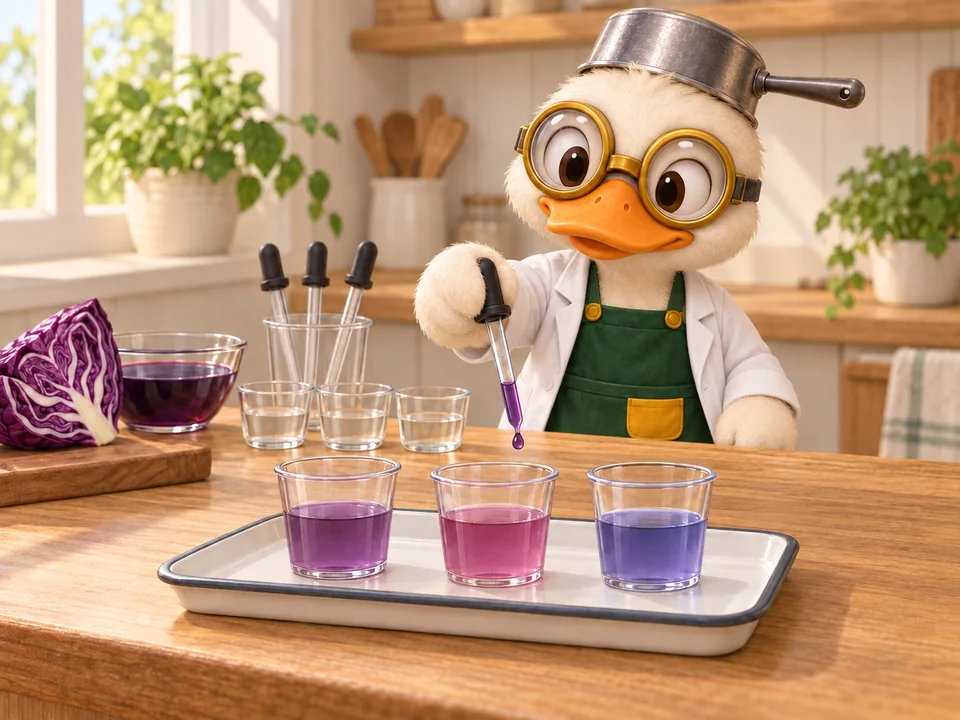
An adult makes a cold cabbage extract. Compare water, vinegar and a mild baking-soda solution, using equal amounts and careful color notes.
Proposed procedure; kitchen trial pending. Explore with an adult and follow the preparation and handling notes.
- Hands-on time
- 25 min
- Total time
- About 30 min
- Difficulty
- Easy
- Participation
- Adult setup
Before you investigate
A thoughtful setup.
Do not taste the indicator, test liquids or finished samples. Color cannot certify food safety.
The adult’s part
- Prepare the cold extract and measure the named test liquids.
- Supervise dropper use and finish disposal.
Tools & heat
- Use sturdy plastic cups, separate droppers, a leak-checked bag and splash goggles.
- No stove, kettle or knife is required.
Ingredients & allergens
- Red cabbage, water, white vinegar and baking soda only.
- Do not substitute cleaning products or combine finished samples.
- Check the actual ingredient labels, including vinegar, and avoid ingredients or shared tools unsuitable for your household.
- A missing precautionary label is not a guarantee of no cross-contact.
Prepare your space
- Work on a wipeable tray with white paper beneath the cups.
- Keep food being prepared for eating separate from the test area.
Build the relevant habits
Review or print my preparation checklist
Checking this browser…
Discover
What you’ll learn.
- Use an unchanged water comparison when interpreting color.
- Describe a qualitative acid–base indicator without inventing a pH number.
- Separate an observation from an explanation.
Change: Which test liquid is added: plain water, white vinegar or the defined baking-soda solution.
Keep the same: 1 tablespoon of the same cabbage extract in each test cup · 5 drops from matching droppers · Cup size, lighting and white background · One gentle swirl and the same observation interval
My prediction
Try it
Follow your question.
Adult: make the cold indicator
Put the torn leaves and 1 US cup room-temperature water in the sturdy bag. Seal, check the closure, and press gently on the tray for about 2 minutes, until the liquid is clearly blue-purple. Strain into the bowl. If it remains very pale, use fresh darker leaves and prepare a new batch; do not heat it as an improvised shortcut.
Care at this step: Adult prepares the cold extract on the tray; wear splash goggles.
Build three matching starting samples
Label the test cups Water, Vinegar and Baking soda. Measure 1 tablespoon of the same extract into each. Place them on white paper and record the starting appearance before adding anything.
Add the test liquids
Use the separate droppers to add 5 drops of the matching test liquid to each cup. Give each cup one gentle swirl without splashing. Leave all three open.
Care at this step: Keep cups open, use only the named ingredients and keep droppers separate.
Look now, then look again
Describe each cup immediately and again after 1 minute under the same light. Compare each with Water. If the difference is faint, record that result; do not keep adding drops until it matches a picture.
Make a cautious explanation
Write one sentence naming the change you observed and the water comparison. Add a second sentence about what you cannot tell: this homemade extract has no calibrated pH scale.
Finish the bench
The adult discards cabbage solids, then disposes of each small liquid sample separately with plenty of water. Wash cups and tools, wipe the tray and wash hands. Keep none of the samples for eating.
Care at this step: Adult disposes of each small sample separately and completes washing.
Observe
Look a little closer.
- Record each cup’s starting color and its color after 1 minute; include the label with every sketch.
- Which change was clearest compared with the water cup?
- Was the liquid cloudy or the color too faint to judge? Record uncertainty.
- What did you observe directly, and what explanation did you add afterward?
Different results are useful. Record what you see, rather than trying to match an expected answer.
My observations
Understand
What’s going on?
Red cabbage contains anthocyanin pigments whose color responds to their chemical surroundings, including acidity. Vinegar and baking-soda solution can shift the extract differently while water helps show what the extract looked like without those ingredients. A visible shift is evidence that the liquid’s surroundings changed. It is not an exact pH reading: concentration, the cabbage itself and viewing conditions all affect the result.
Use this in your kitchen
Cabbage is a useful reminder that an ingredient’s surroundings can alter its appearance. When a recipe adds an acidic ingredient, a color change can accompany the recipe step. That observation cannot replace a tested recipe, an ingredient check or food-safety guidance.
Go deeper
An indicator can exist in forms that interact differently with light. This is why changing the liquid can change its visible color. Our three cups are a comparison, not a calibration: we have neither known pH standards nor a measured acidity scale. Color photographs are also affected by lighting and camera settings, so the written conditions belong beside the picture.
Why results may differ
- The extract strength and the size of a drop are only approximately controlled.
- Five drops may produce a subtle result; an unclear result is valid.
- The illustration does not provide a pH chart or guarantee particular shades.
- This activity cannot test whether food, drinking water or cleaning products are safe.
Try again
One discovery.
Another question.
Make a fresh batch on another day and repeat the same three conditions. Keep the five-drop dose and compare whether your descriptions are consistent; change only one planned factor in a later trial.
My conclusion and next question
Finish thoughtfully
Clean up
- Wash equipment and hands; wipe colored spills promptly.
Dispose of the samples
- Put cabbage solids in household food waste as locally accepted.
- Adult pours the small liquid samples away separately with plenty of water; do not store them.
For parents & educators
Learning objectives
- Identify a comparison sample.
- Report color changes with conditions and uncertainty.
- Explain why qualitative evidence is not a numerical pH measurement.
Prepare & make space
Allow about 10 minutes for adult cold extraction and ingredient setup. Check that the indicator is visible against white paper. Total time is an estimate pending a kitchen trial.
The adult’s part
Prepare all test liquids, supervise dispensing and disposal, and maintain the food-only boundary. No heating or household-cleaner variants belong in this activity.
Talk about it
- Why does the Water cup matter?
- Would changing the number of drops make comparisons harder?
- How could lighting change the description without changing the liquid?
A simple way to join in
An adult dispenses while the learner points to labeled cups and dictates similarities or differences. Offer large high-contrast labels and verbal descriptions.
Take it further
Repeat the identical comparison with a new extract batch and discuss repeatability. Do not assign pH numbers from internet color pictures.
Explore as a group
Assign measurer, label checker and recorder roles. Each group uses one extract batch and its own three droppers; share observations rather than liquids.
Clean up
Discard the solids and small liquid samples, wash equipment and wipe dye spills promptly. Record cleanup before marking the activity finished.
Behind the explanation
- American Chemical Society: Red Cabbage Indicator ↗
Supports cold extraction in a sealed bag using cabbage leaves and a cup of water, tablespoon portions of indicator, and dropwise testing. Only food ingredients from its examples are used here.
- FDA: Selecting and Serving Produce Safely ↗
Rinse produce under running water before cutting; do not use soap on produce. Use clean hands, tools and surfaces.
- FDA: Have Food Allergies? Read the Label ↗
Ingredient labels and cross-contact matter; absence of a voluntary precautionary statement is not a guarantee that an allergen is absent.
Activity exp-cabbage · Content version 1 · Sources checked 2026-09-25 · Proposed procedure; kitchen trial pending