Ingredients / Kitchen skills
The yeast bubble investigation
Does a defined addition of sugar change visible activity in warm baker’s yeast?
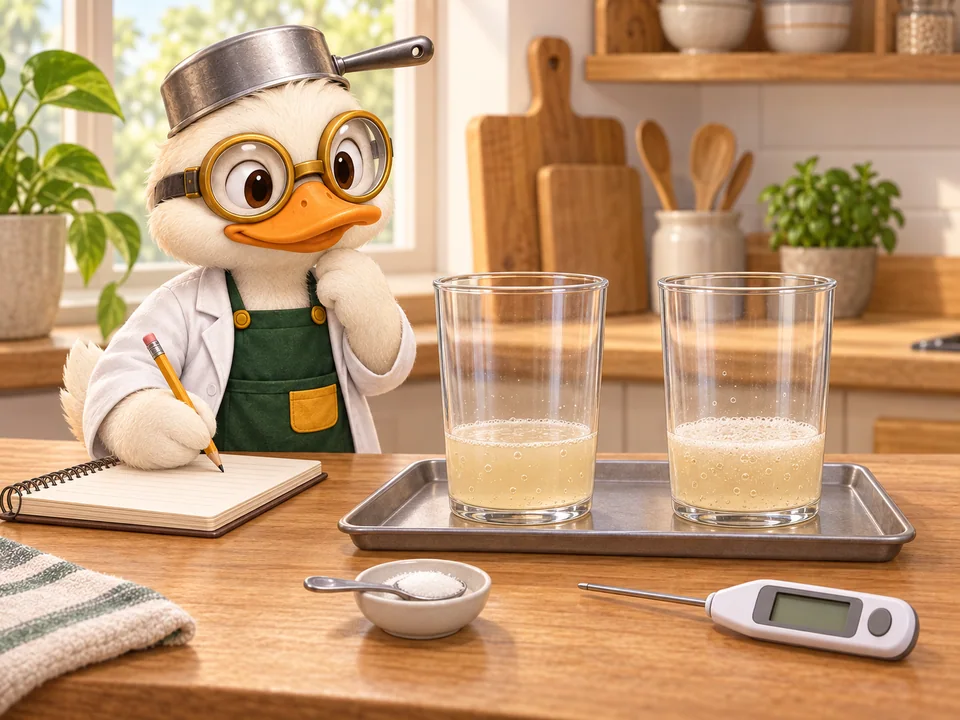
Compare two open cups of the same yeast and water. Add sugar to one and record bubbles and foam over fifteen minutes.
Proposed procedure; kitchen trial pending. Explore with an adult and follow the preparation and handling notes.
- Hands-on time
- 20 min
- Total time
- About 30 min
- Difficulty
- A little practice
- Participation
- Explore together
Before you investigate
A thoughtful setup.
Do not drink, taste, bake with or save the experimental mixtures.
The adult’s part
- Warm, measure and pour the water; handle all appliances.
- Supervise the complete short session and dispose of both mixtures.
Tools & heat
- Use a food thermometer and two matching open cups of at least 500 mL.
- Never attach lids, balloons or other covers that can trap gas.
Ingredients & allergens
- Active dry baker’s yeast, water and granulated sugar only.
- No flour, raw dough or unknown starter culture.
- Read the actual yeast and sugar labels and use tools suitable for household ingredient requirements.
- Do not infer absence of cross-contact from a missing “may contain” statement.
Prepare your space
- Keep open cups on a tray away from the edge and away from eating utensils.
- An adult manages warming separately from the learner observation area.
Build the relevant habits
Review or print my preparation checklist
Checking this browser…
Discover
What you’ll learn.
- Use a no-added-sugar comparison.
- Observe visible gas-related activity without treating foam as a cell count.
- Explain why a result can depend on ingredient condition and temperature.
Change: Adding 1 teaspoon granulated sugar versus adding no sugar.
Keep the same: 2 1/4 teaspoons of the same active dry yeast per cup · 1/2 US cup water per cup, from the same prepared batch · Matching open cups, starting temperature and mixing method · Observation times at 0, 5, 10 and 15 minutes
My prediction
Try it
Follow your question.
Adult: prepare the warm water
Warm 1 US cup water and use the thermometer to check 110–115°F. If outside that range, adjust the water before adding yeast. Divide it equally between the two open cups.
Care at this step: Adult handles the warm water and verifies the specified procedure temperature.
Change only the sugar addition
Add 1 teaspoon sugar to the labeled sugar cup and stir until dissolved. Stir the no-added-sugar water with its separate spoon for the same amount of time. Add 2 1/4 teaspoons active dry yeast to each cup.
Mix and start the record
Stir each for about 20 seconds, using the same motion and its own spoon. Note the starting time and any difference in start times. Record the liquid level, visible granules and any foam already introduced by stirring.
Care at this step: Keep both cups open for the entire activity; never seal an active mixture.
Look at five and ten minutes
At 5 minutes, then 10 minutes from the start, record the visible bubbles and foam in each cup. Use a ruler outside the cup to estimate foam-layer height in millimeters if a clear layer exists. Do not stir again or add more ingredients.
Make the fifteen-minute comparison
At 15 minutes, record both cups one last time. Compare their changes from the starting view. Note “no clear difference” when appropriate; do not extend the session until the prediction comes true.
Care at this step: End observations at the planned time instead of feeding or keeping the samples.
Explain, then dispose
Write a claim supported by your actual observations, then name a limitation. The adult disposes of the mixtures at the end of the session, rinses the cups and washes the tools, tray and hands.
Care at this step: Adult disposes of both mixtures and completes washing.
Observe
Look a little closer.
- At 0, 5, 10 and 15 minutes, what changed in each labeled cup?
- Was foam already present immediately after stirring?
- Was there a clear foam layer to measure, or only scattered bubbles?
- Did both cups begin with the same water temperature and similar mixing?
Different results are useful. Record what you see, rather than trying to match an expected answer.
My observations
Understand
What’s going on?
Baker’s yeast is a living fungus that can use sugars and release carbon dioxide. Gas bubbles can contribute to a foam layer, so added sugar may change the visible activity. The no-added-sugar cup is a comparison, not a promise of zero bubbles. Stirring also adds air, and foam depends on how bubbles form and persist. Record what your yeast actually did.
Use this in your kitchen
Yeast activity matters in breadmaking, where a dough structure can retain gas. These open water mixtures contain no flour and do not model that structure. They show one ingredient comparison; they cannot tell you exactly how tall a loaf will rise or replace a recipe’s fermentation instructions.
Go deeper
Yeast can produce carbon dioxide through different metabolic pathways depending on conditions, including oxygen availability. An open cup does not establish an oxygen-free experiment. Bubbles alone therefore cannot prove which pathway dominated, identify the exact gas volume, or count living cells. They are a visible response to compare under stated conditions.
Why results may differ
- Yeast age, handling and starting temperature influence visible activity.
- Foam height is not a direct measurement of gas production or yeast population.
- The two small cups do not provide a repeatability estimate.
- This does not culture unknown microbes or demonstrate safe storage of fermented food.
Try again
One discovery.
Another question.
Use a fresh paired setup on another day with the same yeast type, water temperature and quantities. Compare the pattern over the same fifteen minutes, then discard both mixtures again.
My conclusion and next question
Finish thoughtfully
Clean up
- Wash cups, spoons and hands; wipe the tray and any spills.
Dispose of the samples
- Adult discards the small mixtures promptly after the session and rinses away residue with water.
- Do not store, feed or maintain the mixtures as a culture.
For parents & educators
Learning objectives
- Describe the purpose of a no-added-sugar control.
- Record change over time with an imperfect visible proxy.
- Avoid inferring an exact biological rate from foam height.
Prepare & make space
Have an adult prepare and measure the water. Read the active dry yeast label and use matching 500 mL cups so visible foam has room.
The adult’s part
Manage all water warming, check the thermometer and keep both vessels open. No balloons, seals, flour or sample tasting are part of the task.
Talk about it
- Why record the view immediately after stirring?
- Could two cups produce gas but hold foam differently?
- What does the open container tell us about the limits of a fermentation claim?
A simple way to join in
Use descriptions such as “scattered bubbles,” “foam layer” and “little visible change.” A ruler is optional when the layer is indistinct.
Take it further
Repeat the whole paired comparison and graph foam height only where it could be measured consistently; label missing measurements rather than replacing them with zero.
Explore as a group
An adult prepares water for each pair. Learners take turns observing the same elapsed times and compare records without exchanging mixtures.
Clean up
Discard both mixtures after the fifteen-minute observation period; rinse away residue, wash tools and wipe the tray.
Behind the explanation
- USDA Agricultural Research Service AgLab: Experimenting with Yeast ↗
Supports an open-bowl comparison of yeast in warm water with and without added sugar, observed over 15 minutes.
- Red Star Yeast: Active Dry Yeast ↗
The manufacturer’s activity check uses 1/2 cup water at 110–115°F, 1 teaspoon sugar and 2 1/4 teaspoons active dry yeast. Here the same yeast and water quantities are also used in a no-added-sugar comparison.
- The Open University: The Science of Nutrition — Explain Your Results ↗
Explains carbon dioxide production by baker’s yeast and why access to oxygen affects the metabolic pathways in an open setup.
- FDA: Handling Flour Safely — What You Need to Know ↗
Raw flour is not a ready-to-eat food. Do not taste raw dough or use raw-flour dough for children’s play; this activity does not use flour.
- FDA: Have Food Allergies? Read the Label ↗
Ingredient labels and cross-contact matter; absence of a voluntary precautionary statement is not a guarantee that an allergen is absent.
Activity exp-yeast · Content version 1 · Sources checked 2026-09-25 · Proposed procedure; kitchen trial pending