Ingredients / Texture / Kitchen skills
Where does the water travel?
Where can we see a colored-water trail inside a celery leaf stalk?
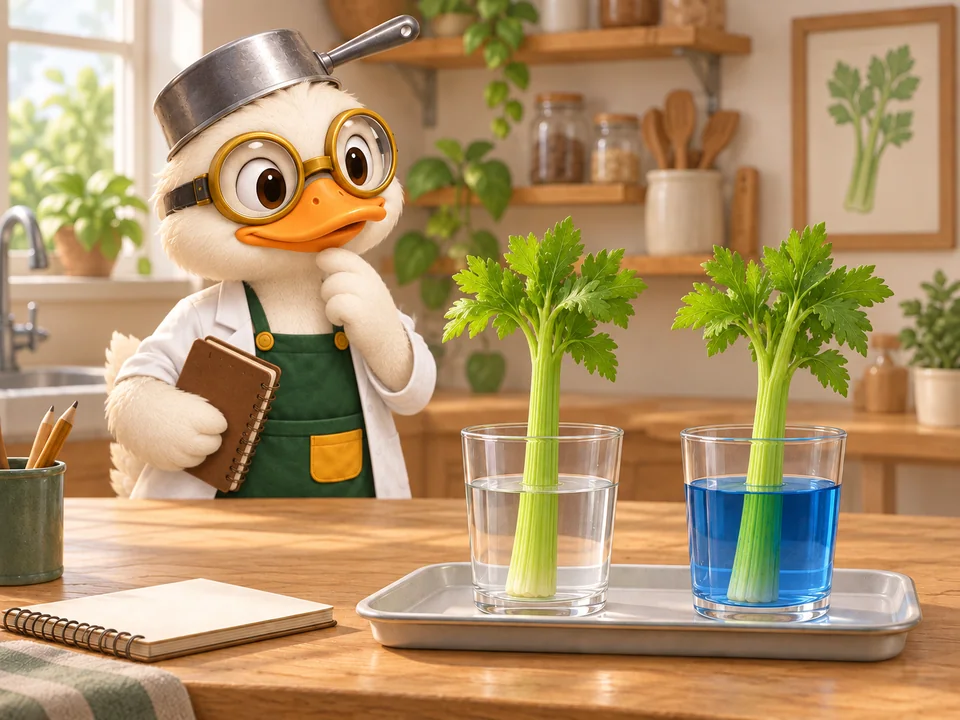
Follow two matched leafy celery stalks, one in blue water and one in plain water. Observe over four hours, then let an adult reveal a cross-section.
Proposed procedure; kitchen trial pending. Explore with an adult and follow the preparation and handling notes.
- Hands-on time
- 25 min
- Total time
- About 255 min
- Difficulty
- Easy
- Participation
- Adult setup
Before you investigate
A thoughtful setup.
The celery, sections and colored or plain water are observation samples and are discarded after the session.
The adult’s part
- Rinse and trim the stalks, then make the final cross-sections.
- Choose a secure location and discard samples after the session.
Tools & heat
- Adult-only knife and stable cutting board.
- Sturdy clear cups on a tray; no hot water or appliances.
Ingredients & allergens
- Fresh celery, water and labeled food coloring only.
- Check celery and food-coloring ingredients against household requirements; foods outside the U.S. major-allergen list can also matter.
- Use suitable clean tools and do not collect personal allergy details in the notebook.
Prepare your space
- Keep cups stable, away from direct sun, heat, pets and food being served.
- Put away the knife between adult cutting steps.
Build the relevant habits
Review or print my preparation checklist
Checking this browser…
Discover
What you’ll learn.
- Use dye as a visible tracer rather than a measure of all water movement.
- Connect a celery cross-section with xylem pathways.
- Record changes at planned intervals without forcing a result.
Change: Whether the celery stands in plain water or water with 10 drops of blue food coloring.
Keep the same: 100 mL of the same starting water in matching cups · Similar stalk length, thickness and leaf area from one bunch · Location, light and starting time · Observation visits at 0, 1, 2 and 4 hours
My prediction
Try it
Follow your question.
Adult: prepare a matched pair
Rinse, select and trim the two leafy stalks as described above. Record their approximate lengths and any obvious differences. The pair will be similar, not perfectly identical.
Care at this step: Adult performs every cut on a stable board.
Set up plain and colored water
Label the cups Plain and Blue. Put 100 mL water in each. Add 10 drops blue food coloring to Blue and stir. Put one stalk upright in each cup with its freshly cut bottom submerged; keep the leaves above the water.
Record the starting view
Note the time and sketch both stalks. Mark the water level on each cup. Write a prediction about where color may become visible. Leave both cups in the same secure place.
Return at the planned times
At 1 hour and 2 hours, inspect both stalks without taking them out or adding more dye. Record where any color is visible, including “no visible change.” Observe again at 4 hours. If a cup spills or a stalk falls over, record that interruption.
Care at this step: Do not taste, add ingredients or extend the setup overnight.
Adult: reveal the inside
After the 4-hour observation, the adult takes out the stalks and cuts a thin cross-section from each at the same distance above the bottom. Put the labeled sections side by side on a white plate and compare the colored dots or streaks with the plain sample.
Care at this step: Adult alone cuts the final sections.
Trace, explain and finish
Draw the route suggested by your observations and distinguish visible dye from inferred water movement. Discard both stalks and sections, pour away the water, and wash cups, board, plate and hands.
Care at this step: Discard the samples and wash all contact surfaces.
Observe
Look a little closer.
- Where was color visible at 0, 1, 2 and 4 hours: bottom, stalk, leaf veins, or nowhere obvious?
- What did the plain-water stalk look like at the same time?
- Which parts of the cross-section were colored and which were not?
- Did differences in stalk thickness, leaf area or placement make the comparison less even?
Different results are useful. Record what you see, rather than trying to match an expected answer.
My observations
Understand
What’s going on?
Celery’s leaf stalk contains xylem, pathways that carry water toward the leaves. Blue food coloring can make some of that route visible. Water loss from leaves through transpiration helps draw water along connected pathways. The plain-water stalk can also take up water even though it lacks a blue tracer; absence of dye is not evidence that no water traveled.
Use this in your kitchen
A crisp vegetable is a structured, water-containing tissue, not an empty straw. Looking at a cross-section can help connect its visible fibers and texture with the plant’s organization. This demonstration explains a pathway; it does not show that soaking will remove contaminants or make any vegetable safe to eat.
Go deeper
Cohesion between water molecules helps maintain a connected water column, while evaporation from leaves contributes to water movement. Actual movement depends on the plant’s condition and surroundings. Dye is an imperfect stand-in: it may stain some tissue more clearly than others, so a colored pattern is a qualitative trace rather than a speedometer or a map of every moving substance.
Why results may differ
- Stalks from one bunch still differ in age, damage, leaf area and water status.
- The strength and visibility of food-coloring brands vary.
- Visible dye movement does not measure total water uptake or prove that an uncolored area contains no water.
- The four-hour window may produce only a faint trail; report that honestly.
Try again
One discovery.
Another question.
On another day, repeat with a fresh matched pair under the same conditions. Compare the time when color first became visible. Do not retain old samples for the repeat.
My conclusion and next question
Finish thoughtfully
Clean up
- Wash cups, plate, knife, board and hands; wipe coloring spills.
Dispose of the samples
- Discard all celery pieces after the four-hour observation session.
- Pour the small water samples down the sink and rinse.
For parents & educators
Learning objectives
- Locate visible transport pathways in plant tissue.
- Distinguish a tracer from the thing being traced.
- Use time-stamped observations and a comparison sample.
Prepare & make space
Allow about 10 minutes for adult setup and schedule short observation visits over four hours. Similar leafy celery is more useful than leafless pieces.
The adult’s part
Do all trimming and cross-section cuts. Set a clear end to the observation-only session and discard the cut produce afterward.
Talk about it
- Why might plain water travel without leaving a blue trail?
- What part of our drawing was seen and what part was inferred?
- Could one stalk’s larger leaf area affect the result?
A simple way to join in
A learner can describe changes aloud while an adult records the times. Use a magnifier for the cross-sections if available; it is not required.
Take it further
Use a ruler to mark the highest clearly visible color at each visit without turning that into the speed of all water movement.
Explore as a group
Keep pairs labeled by conditions rather than children’s names. Give each group its own matched pair and compare the range of visible outcomes.
Clean up
Discard celery and sections after the final visit. Wash the board, knife, cups and hands; wipe dye spills.
Behind the explanation
- University of California Agriculture and Natural Resources: The Great Celery Experiment ↗
Supports a freshly trimmed leafy celery stalk in colored water, 10 drops of dye, and observations after 1, 2 and 4 hours.
- OpenStax Biology 2e: Transport of Water and Solutes in Plants ↗
Explains water transport through xylem and the role of water potential, cohesion and transpiration.
- FDA: Selecting and Serving Produce Safely ↗
Rinse produce under running water before cutting; do not use soap on produce. Use clean hands, tools and surfaces.
Activity exp-plant-water · Content version 1 · Sources checked 2026-09-25 · Proposed procedure; kitchen trial pending