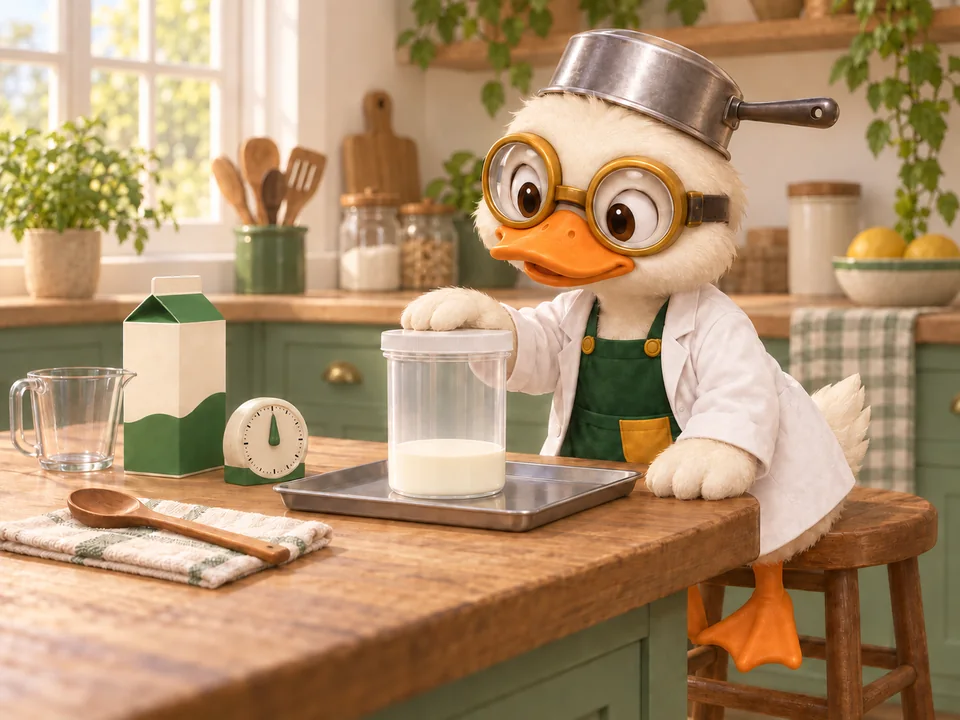
Ingredients / Texture / Mixtures
Catch some air
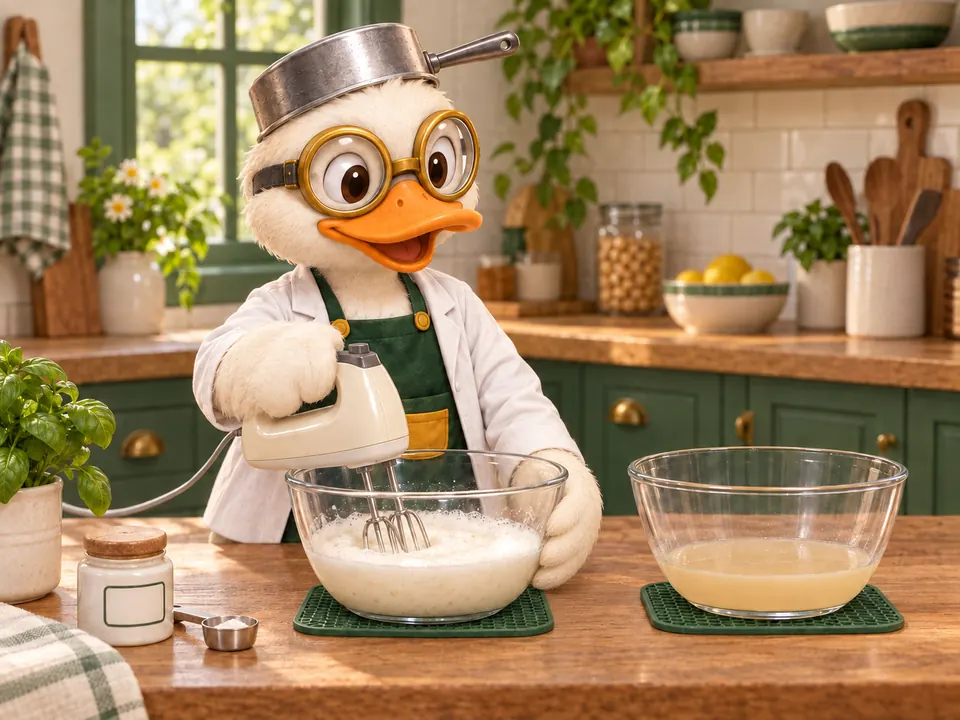
How does electric whipping change the appearance of canned-chickpea liquid compared with leaving it still?
An adult whips one of two matched portions. Follow the bubbles and any drainage after mixing stops, and record what this particular batch does.
Proposed procedure; kitchen trial pending. Explore with an adult and follow the preparation and handling notes.
- Hands-on time
- 20 min
- Total time
- About 30 min
- Difficulty
- A little practice
- Participation
- Explore together
Before you investigate
A thoughtful setup.
Keep every investigation sample separate from food to be served. Do not taste these samples.
The adult’s part
- An adult opens cans, removes lids, checks the appliance and operates the mixer throughout.
- An adult secures unused chickpeas separately for ordinary food storage before the investigation begins.
Tools & heat
- Keep fingers, hair, loose clothing and utensils away from moving beaters. Switch off and wait for a complete stop before lifting them.
- Unplug before inserting, removing or cleaning attachments, following the specific mixer manual.
- Do not use an appliance with a cracked, damaged or loose cord. Unplug small appliances when not in use and avoid overloading outlets.
Ingredients & allergens
- Use newly opened commercially canned chickpeas; combine the drained liquid so both portions come from one mixed batch.
- Do not concentrate the liquid on a stove for this activity. Do not substitute raw egg.
- Read ingredient information every time, even for a familiar product. A “Contains” statement identifies major allergens used as ingredients if that statement is present; not every product has one.
- Chickpea can cause allergy even though it is not one of the nine major U.S. allergens. Check chickpea and cream-of-tartar labels and shared tools.
Prepare your space
- Scrub hands with soap and running water for at least 20 seconds, including backs, between fingers and under nails. Rinse and dry with a clean towel.
- Use two deep stable bowls on nonslip mats. Keep the mixer handle, outlet, hands and surrounding cord area dry; route the cord away from edges and water.
- Refrigerate perishable food within 2 hours. If exposed to temperatures above 90°F (32°C), refrigerate within 1 hour. Discard perishables left out beyond the applicable limit.
Review or print my preparation checklist
Checking this browser…
Discover
What you’ll learn.
- Describe a foam as gas bubbles dispersed in a liquid.
- Compare an actively mixed sample with a still sample.
- Distinguish foam appearance from a measurement of air volume.
Change: Whether the sample receives five minutes of electric whipping after the same initial gentle stirring.
Keep the same: 120 mL pooled aquafaba and 1/2 teaspoon cream of tartar in each bowl · Matching bowls and starting ingredient temperature · Five gentle initial stirs per sample · Same observation clock, viewing angle and resting location
My prediction
Try it
Follow your question.
Match the starting portions
Measure 120 mL aquafaba and 1/2 teaspoon cream of tartar into each labeled bowl. Give each five gentle spoon stirs using separate spoons, then set the spoons aside. Sketch both starting surfaces and record the product and starting time.
Care at this step: Only the adult handles can lids and the electrical setup.
Make a prediction
Choose what you think will change and why. Position both bowls where they can remain undisturbed. A learner may operate the timer or record notes while the adult handles the electrical equipment.
Whip one, leave one still
The adult puts the beaters into Whipped before switching on, starts on low to limit splashes and uses a suitable higher whipping setting for the remainder of a total five minutes. Record the settings and any pauses. Leave Still untouched for the same period. Stop sooner if the mixer manual or safe operation requires it; note the actual duration. Five minutes is a fixed trial time, not a promise of stiff peaks.
Care at this step: The adult alone operates the mixer; pause the trial if the equipment instructions require a shorter running period.
Observe with the mixer stopped
Adult switches off, waits for the beaters to stop and unplugs before moving the appliance aside. Look at both bowls from the same angle. Record bubbles, foam, surface texture and any liquid beneath foam. A sketch can show apparent expansion; do not report it as a measured quantity of trapped air.
Care at this step: Switch off, let beaters stop and unplug before anyone comes close to inspect.
Watch the rest
Leave both bowls still. Compare them five minutes after whipping stopped and again at ten minutes. Keep timing from the same stopping point. Look for larger bubbles, shrinking foam or liquid collecting underneath; no visible change is also a result.
Explain and finish
Use a before-and-after drawing to connect mixing with bubbles. State what you actually saw and one thing this trial could not measure. Discard the mixtures after this observation session and let the adult clean the unplugged mixer.
Observe
Look a little closer.
- What did both portions look like before whipping?
- What mixer settings, duration and pauses were actually used?
- How did the two bowls compare immediately, after five minutes and after ten minutes of rest?
- Was there drainage, larger bubbling, collapse or little visible change?
Different results are useful. Record what you see, rather than trying to match an expected answer.
My observations
Understand
What’s going on?
Whipping pulls air into the liquid and breaks it into bubbles. Substances dissolved or dispersed in aquafaba can help the thin liquid films around bubbles persist. A foam can later drain or collapse as liquid moves and bubbles change. The still sample helps us notice what mixing changed in this batch.
Use this in your kitchen
Aquafaba can supply foam in some tested recipes. Its behavior depends on the product and method, so a foamy bowl does not prove that it can replace egg in every cake or cookie. Use a recipe developed for the ingredient when cooking later.
Go deeper
Aquafaba contains a mixture of compounds rather than one magic foaming ingredient. Proteins, carbohydrates and surface-active substances contribute to behavior, and formulation matters. Cream of tartar is held equal in both samples here; this trial does not isolate its effect. We observe foam appearance, not gas composition, exact air volume or long-term stability.
Why results may differ
- Canned products differ in concentration and ingredients; record the label.
- Mixer speed and bowl geometry can change the result.
- Five minutes may produce little foam or different foam in another batch.
- The trial has one portion per condition and cannot establish a universal whipping time.
Try again
One discovery.
Another question.
Repeat the complete comparison with a fresh batch of the same product and the same recorded mixer routine. Treat a different brand as a new condition, rather than silently replacing the original.
My conclusion and next question
Finish thoughtfully
Clean up
- Adult unplugs the mixer and washes removable attachments as its manual directs. Wash bowls and spoons and wipe the bench.
Dispose of the samples
- Discard both observation mixtures at the end of the session. Refrigerate untouched reserved chickpeas promptly using Keep the refrigerator at 40°F (4°C) or below; check with an appliance thermometer.; they are not investigation samples.
For parents & educators
Learning objectives
- Identify liquid and gas in a foam model.
- Use a still comparison and a fixed observation schedule.
- Avoid equating a large-looking foam with a measured air volume.
Prepare & make space
This proposed setup has not had a QuackPot kitchen trial. Check that the specific mixer reaches the sample and that its permitted running time fits the plan. Record the actual product, bowl, settings, duration and any adaptation.
The adult’s part
Open cans, operate the appliance, protect the electrical workspace and manage ingredient storage. Do not assign beaters to a child.
Talk about it
- What evidence links whipping with the change?
- Why might foam shrink after the motor stops?
- What would we need to measure air quantity rather than describe appearance?
A simple way to join in
Use before/after drawings and a recorder role; the adult does all measuring and mixing.
Take it further
Repeat with a second independently prepared batch. Compare drainage descriptions at the same elapsed times, keeping the original records.
Explore as a group
Use adult mixer operator, timer, before/after artist and recorder roles. Stand clear while the mixer runs.
Clean up
Discard observation mixtures, wash utensils and bowls, and have the adult clean the unplugged appliance according to its manual.
Behind the explanation
- King Arthur Baking: A guide to aquafaba ↗
Supports canned-chickpea liquid, electric mixing and the cream-of-tartar ratio. This paired five-minute trial is our proposed adaptation.
- McGill University Office for Science and Society: What is aquafaba? ↗
Describes foam-forming constituents and an electric-mixing window of three to six minutes; results vary with conditions.
- University of Minnesota: Evaluation of processing conditions and hydrocolloid addition on aquafaba functionality ↗
The research abstract reports that processing and added hydrocolloids affect aquafaba properties; it does not validate this home procedure.
- U.S. Fire Administration: Appliance and Electrical Fire Safety ↗
Supports sound cords, manufacturer instructions and unplugging unused appliances.
- FDA: Have Food Allergies? Read the Label ↗
Supports checking complete ingredient labels and considering cross-contact.
- FoodSafety.gov: Four Steps to Food Safety ↗
Supports clean handling, refrigeration and limits on unrefrigerated time, represented by the lab’s shared safety rules.
Activity exp-aquafaba · Content version 1 · Sources checked 2026-09-25 · Proposed procedure; kitchen trial pending