Texture / Ingredients / Kitchen skills
From cream to something new
What changes when you keep shaking cream?
Listen to the slosh, watch the thickening and look for the moment when a soft mass and a separate liquid appear.
Proposed procedure; kitchen trial pending. Explore with an adult and follow the preparation and handling notes.
- Hands-on time
- 20 min
- Total time
- About 25 min
- Difficulty
- A little practice
- Participation
- Explore together
Before you investigate
A thoughtful setup.
The default is observation-only. Do not taste the handled investigation sample. Optional tasting uses a separate fresh hygienic preparation, suitable ingredients, adult oversight and individual clean utensils; tasting is never needed to complete the investigation.
The adult’s part
- An adult checks pasteurization and labels, measures the cream, checks the container and lid, and tracks its full unrefrigerated time.
- The adult supervises shaking, opens the container over the tray and manages refrigeration or disposal. Stop if a learner is tired or uncomfortable.
Tools & heat
- Use the specified food-safe plastic container with a secure lid and enough empty space. Do not use a fragile glass jar.
- No heating is required; do not warm cream overnight, on a stove or in a microwave to speed the activity.
Ingredients & allergens
- Use pasteurized heavy cream from refrigerated storage and clean food-safe equipment. Keep the unused carton refrigerated.
- The adult follows the perishable-food time and refrigerator rules for the entire setup, observation and cleanup period.
- Contains milk. Pasteurization does not remove milk allergens.
- Check the actual cream label for other ingredients. Provide an appropriate observation role or different activity under the established allergy plan.
Prepare your space
- Wash hands and clear a stable tray. Keep the container below faces during shaking.
- Keep a refrigerator available and separate experiment samples from food prepared for eating.
Build the relevant habits
Review or print my preparation checklist
Checking this browser…
Discover
What you’ll learn.
- Record a sequence of texture changes.
- Connect physical mixing with changes in a food’s structure.
- Recognize that butter and cream arrange fat and water differently.
Change: Accumulated shaking of one sample over time.
Keep the same: The same cream sample and container · A similar shaking motion · The way you inspect and describe the sample
My prediction
Try it
Follow your question.
Notice the starting texture
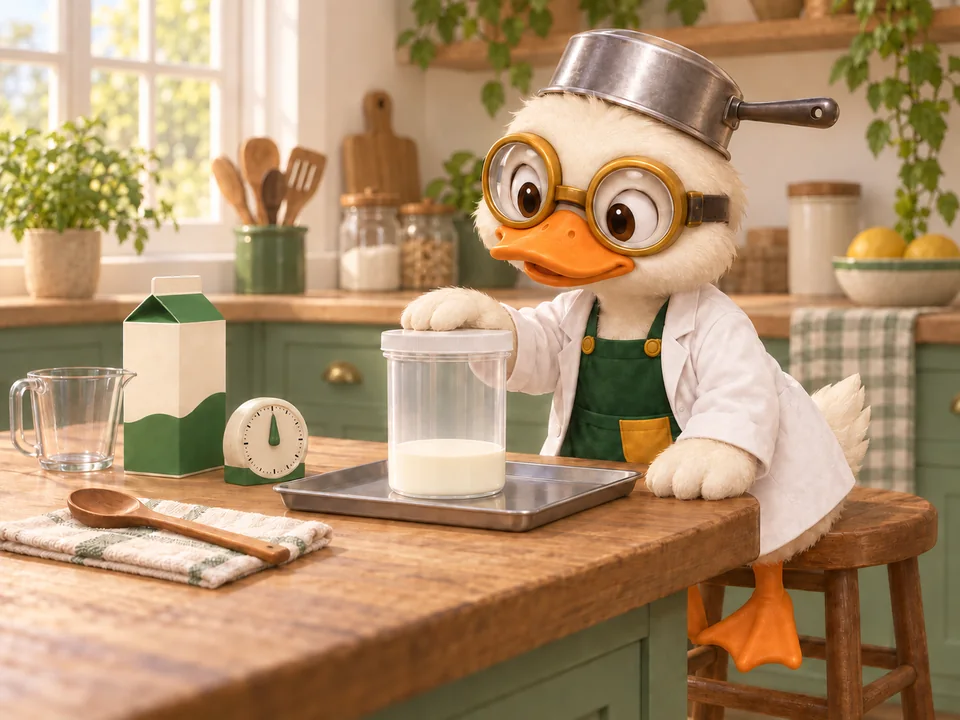
Pour 80 mL cream into the clean container, leaving plenty of empty space. Close the lid. Tilt gently and describe how the cream flows and sounds.
Care at this step: The adult checks the cream label and lid; note when the cream leaves refrigeration.
Begin shaking
Shake back and forth for one minute. Stop, keep the lid closed and tilt gently. Record whether the sound or movement has changed. Start another minute when ready.
Care at this step: Keep the lid closed and the container below face level. Stop if there is a leak.
Follow the changes
Continue in one-minute rounds, resting or taking turns. Look through the container between rounds. It may become thick and move less; record that stage rather than assuming the activity is finished. Total shaking may take around 15–20 minutes and can differ.
Care at this step: Rest or take turns. Include rest periods in the total time out of refrigeration.
Look for separation
Continue until you can distinguish butter granules or a soft mass from a separate liquid, or until you decide to stop. Do not keep shaking through discomfort. If separation has not appeared, record that result and the actual shaking time.
Care at this step: Stop for discomfort or the adult’s handling limit even if separation has not appeared.
Inspect and close the investigation
Ask an adult to open the container over a tray. Use a clean spoon to describe the soft mass if present; carefully pour the separate liquid into a bowl to see it. Record the final appearance, then discard the handled investigation sample. Refrigerate unused cream and any separately prepared food batch promptly.
Care at this step: The adult opens over the tray. Record promptly, then refrigerate an appropriate separately prepared food batch or discard the handled observation sample.
Observe
Look a little closer.
- How did the sound and flow change?
- What stages did you see, and in what order?
- When did a separate liquid become visible, if it did?
- How much actual shaking time and resting time occurred?
Different results are useful. Record what you see, rather than trying to match an expected answer.
My observations
Understand
What’s going on?
Cream contains tiny fat globules dispersed in a watery liquid. Shaking brings globules together and helps them form larger clumps. As butter forms, liquid separates from the fat-rich mass. The ingredients have been rearranged into a very different structure, so the texture changes.
Use this in your kitchen
Whipped cream can move beyond soft peaks and become grainy when mixing continues. Watching texture as you mix is more useful than relying only on a clock.
Go deeper
Butter making involves phase inversion: cream starts as fat dispersed in a water-based continuous phase, while butter has a fat-rich continuous structure containing water. Some milk fat is crystalline and some is liquid; that balance affects how readily globules join and how the butter spreads. The liquid released here is sweet-cream buttermilk, which is different from the cultured buttermilk commonly sold for baking. This observation sequence is not a controlled test of shaking alone because the sample also warms and changes as time passes.
Why results may differ
- Temperature, cream composition, stabilizers, container shape and headspace affect the process.
- Shaking intensity and rest periods make completion times differ.
- Visual changes alone do not measure fat content or prove food safety.
- This single-sample transformation does not isolate every cause of the texture change.
Try again
One discovery.
Another question.
For a separate controlled comparison, use two fresh 80 mL portions from the same carton in identical containers. Compare 5 minutes with 10 minutes of similar shaking, recording rest periods. Keep both within the handling limits and compare at the stated endpoints.
My conclusion and next question
Finish thoughtfully
Clean up
- Clean spills promptly. Wash the container, lid, spoon, bowl and tray, clean the work area and wash hands.
- The adult checks that unused cream was returned promptly and handles any uncertain storage history.
Dispose of the samples
- Discard the handled investigation sample after observing; do not keep it for repeated display or tasting. Follow local waste guidance for collected fatty solids and liquids.
For parents & educators
Learning objectives
- Observe a physical transformation as a sequence.
- Distinguish a demonstration over time from a test with an independent control.
Prepare & make space
Confirm milk-allergy arrangements, clean containers and enough refrigerator space. Premeasure cream if useful.
The adult’s part
Manage dairy handling, lid checks, spills and refrigeration. Offer breaks and a no-handling observation role.
Talk about it
- Which clue was most useful: sound, flow or appearance?
- Why might another group need more shaking time?
- What changes besides shaking as the activity continues?
A simple way to join in
Describe or select the sound and movement while an adult shakes. Draw the beginning, middle and end.
Take it further
Record cream composition and actual shaking time across repeated trials. Discuss why a clock alone cannot identify the texture endpoint.
Explore as a group
Pass a securely closed container between willing participants. Assign observation and timekeeping roles that do not require dairy contact.
Clean up
Discard the handled investigation sample. Refrigerate unused cream and any separate fresh hygienically prepared food promptly. Wash all dairy-contact surfaces and hands. Wash all dairy-contact surfaces and hands.
Behind the explanation
- Mississippi State Extension: Experiments in Food Science Laboratory Manual ↗
Its butter activity uses ⅓ cup heavy cream in a clean lidded jar and observes solids and liquid separating after roughly 15–20 minutes of shaking.
- University of Wisconsin Center for Dairy Research: Butter Science 101 ↗
Churning encourages fat globules to aggregate and produces phase inversion from cream to butter. Cream composition and the balance of crystalline and liquid fat affect processing and texture.
- FDA: Raw Milk Misconceptions and the Danger of Raw Milk Consumption ↗
Choose pasteurized dairy; raw milk can carry harmful pathogens, and pasteurization does not remove milk allergens.
- FDA: Food Safety at Home ↗
Keep perishables refrigerated and limit unrefrigerated time to two hours, or one hour when the surroundings are above 90°F (32°C). Clean hands, tools and work surfaces.
Activity exp-cream · Content version 2 · Sources checked 2026-09-25 · Proposed procedure; kitchen trial pending