Ingredients / Kitchen skills / Measurement
Same cup, different amount
Does a level measure of brown sugar have the same mass when it is loose or packed?
Fill the same size measure two ways, then let a scale help you compare. Repeat each method and keep every reading, including surprises.
Proposed procedure; kitchen trial pending. Explore with an adult and follow the preparation and handling notes.
- Hands-on time
- 25 min
- Total time
- About 25 min
- Difficulty
- Easy
- Participation
- Adult setup
Before you investigate
A thoughtful setup.
Keep every investigation sample separate from food to be served. Do not taste these samples.
The adult’s part
- Check the scale, cup capacity and stable work surface. Help learners tare each cup separately.
Tools & heat
- Use a blunt straight scraper; no sharp knife is needed.
- Keep sugar and moisture out of the scale buttons and follow its cleaning instructions.
Ingredients & allergens
- Use ordinary food-grade brown sugar from one labeled package. Keep the experiment bowl separate from the original package.
- Read ingredient information every time, even for a familiar product. A “Contains” statement identifies major allergens used as ingredients if that statement is present; not every product has one.
- Choose materials and tools suitable for everyone taking part; do not assume a short ingredient list rules out allergy or cross-contact.
Prepare your space
- Scrub hands with soap and running water for at least 20 seconds, including backs, between fingers and under nails. Rinse and dry with a clean towel.
- Work over a clean dry tray; wipe scattered sugar so the scale sits flat.
Build the relevant habits
Review or print my preparation checklist
Checking this browser…
Discover
What you’ll learn.
- Distinguish volume from mass.
- Tare a container before weighing its contents.
- Use repeated pairs of readings to describe variation.
Change: Whether brown sugar is spooned loosely or pressed into the same measuring volume.
Keep the same: Sugar batch and starting condition · Cup capacity and level rim · Scale, units and individual tare for each container · Person filling the cups, leveling tool and packing routine
My prediction
Try it
Follow your question.
Prepare a fair comparison
Write your prediction and the cup capacity. Put the first empty cup on the scale and tare it. Remove it for filling. If the scale switches off or resets, tare the empty cup again before using that reading.
Care at this step: An adult checks the scale and supplies a blunt leveling tool.
Fill loosely and weigh
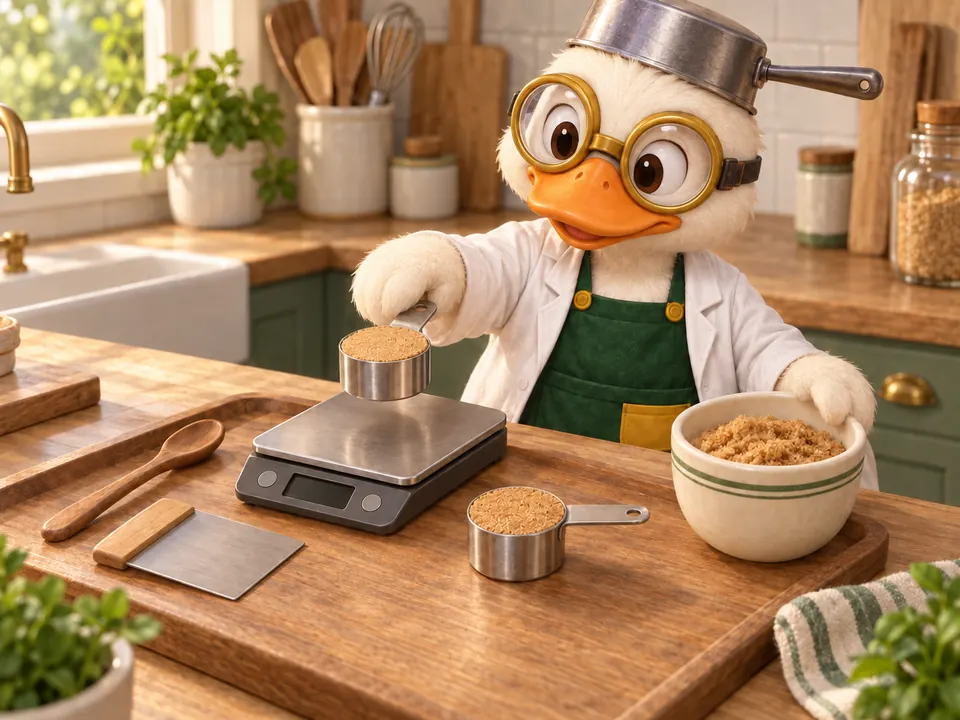
Spoon sugar into Loose without tapping or pressing. Overfill slightly, then sweep the blunt straight edge across the rim once, catching extra sugar on the tray. Place the cup on the scale and record the stable gram reading. Keep the sugar surface level with the rim, not heaped.
Pack the same volume
Tare the other empty cup separately, then remove it from the scale for filling. Fill it halfway, press with the back of the spoon three times, then fill above the rim and press three more times. Add enough sugar to reach the rim and level it with the same scraper. Return the cup to the scale and record the stable mass. These counted presses standardize our method; they do not measure force.
Repeat without erasing the first pair
Empty both cups into the experiment bowl, gently loosen clumps and recover trial sugar from the clean tray. Repeat both methods twice more, taring empty cups each time. Start with Packed in trial 2 and Loose in trial 3. Use the same person and pressing routine for all pairs.
Care at this step: Return trial sugar only to the experiment bowl, never the original package.
Compare the complete set
For each trial, subtract Loose from Packed. A negative difference is allowed. Find the lowest and highest reading for each method; an optional average uses all three readings. Describe the pattern and variation without replacing your values with a chart value.
Explain the measure
Draw two equal-sized cup outlines with different amounts of space between particles. Explain how the same outer volume can hold different amounts of sugar. Name one reason that another person or sugar package might give different readings, then clean up.
Observe
Look a little closer.
- What were all three loose and all three packed masses, including units?
- Did Packed minus Loose have the same sign in every pair?
- How much did repeated readings vary within each method?
- Were the cup rims level, and did any sugar spill before weighing?
Different results are useful. Record what you see, rather than trying to match an expected answer.
My observations
Understand
What’s going on?
A measuring cup fixes an outside volume. Brown sugar crystals and clumps can leave different amounts of space between them. Pressing can fit more material inside that volume, so the scale may read a greater mass. That is a change in how the sample is packed, not evidence that its individual sugar molecules became heavier.
Use this in your kitchen
Words such as packed and level are part of a recipe’s measurement. If a recipe supplies a mass, weighing avoids deciding how firmly to fill a cup. Do not turn this one bag’s results into a universal cup-to-gram conversion.
Go deeper
Mass per occupied bulk volume is sometimes called bulk density. Here the occupied volume includes spaces between pieces, and we have not measured the density of a sugar crystal. The range of repeated readings shows part of the uncertainty in our filling method; a 1 g scale cannot resolve differences smaller than its displayed step.
Why results may differ
- The same count of presses does not produce exactly the same force.
- Humidity, clumps, grain size and sugar brand can change packing.
- Three trials from one batch do not establish a universal conversion.
- Different cups may have slightly different actual capacities even when their markings match.
Try again
One discovery.
Another question.
Repeat on another day with the same sugar and one new person filling both methods. Keep the original set, label the new set and compare variation before making a broader claim.
My conclusion and next question
Finish thoughtfully
Clean up
- Brush sugar into the experiment bowl before wiping the table. Clean and dry measures; clean the scale as its manufacturer directs.
Dispose of the samples
- Put handled trial sugar into food waste or household trash under local rules. Do not return it to food storage.
For parents & educators
Learning objectives
- Use gram units and tare correctly.
- Separate an observation from an explanation.
- Recognize repeated measurement as useful evidence.
Prepare & make space
Verify that a quarter-cup sample gives a readable mass on the available scale and that its automatic shutoff will not lose tare unnoticed. Prepare a blank six-reading table.
The adult’s part
Demonstrate the blunt scraper and scale without supplying an expected number. Check each cup’s empty tare.
Talk about it
- Why does a matching cup not guarantee a matching mass?
- What does the spread among repeats tell us?
- Which details would another group need to reproduce your method?
A simple way to join in
Make one pair together, draw the two cups and describe the readings as larger, smaller or the same at this scale’s resolution.
Take it further
Calculate each method’s mean and range using the original measurements. Explain why extra decimal places from a calculator do not improve the scale.
Explore as a group
Assign filler, scale reader and recorder. One filler completes a three-pair set before roles rotate into a separately labeled set.
Clean up
Keep all handled sugar out of the food package; clean and dry the tools and work area.
Behind the explanation
- Utah State University Extension: Healthy Snacks curriculum — Measuring ↗
Explains spooning, packing brown sugar and leveling dry measures; the matched repeated comparison here is an adaptation.
- King Arthur Baking: Ingredient Weight Chart ↗
Names packing as part of the brown-sugar measure. A reference value is not a predicted result for this investigation.
- King Arthur Baking: Why a digital kitchen scale is a baker’s best friend ↗
Explains weighing in grams and subtracting the container with tare.
- FDA: Have Food Allergies? Read the Label ↗
Supports checking complete ingredient labels and considering cross-contact.
Activity exp-sugar-mass · Content version 1 · Sources checked 2026-09-25 · Proposed procedure; kitchen trial pending