Ingredients / Kitchen skills
Change one thing
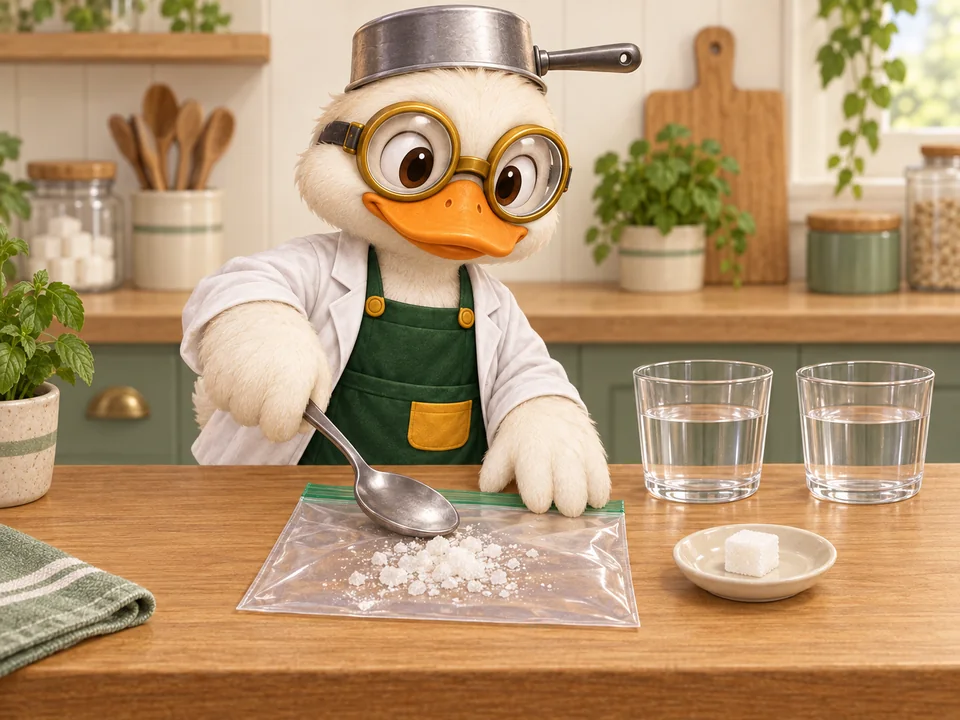
Does breaking a sugar cube change what you observe as it dissolves?
Keep the sugar amount and water conditions alike. Change the piece size, then find out why a fair comparison needs a plan.
Proposed procedure; kitchen trial pending. Explore with an adult and follow the preparation and handling notes.
- Hands-on time
- 15 min
- Total time
- About 25 min
- Difficulty
- A little practice
- Participation
- Explore together
Before you investigate
A thoughtful setup.
Do not eat the cubes or drink the sugar water. Record visible grains and the chosen visual endpoint.
The adult’s part
- An adult helps crush the cube gently in the closed bag, checks the bag remains intact and supervises the transfer.
Tools & heat
- Use the back of a spoon on a stable surface; no knife, sharp tool or heavy striking tool is needed.
- Use matching cups, a food-safe bag, timer and optional scale. No heat is required.
Ingredients & allergens
- Use two sugar cubes from the same identified packet and room-temperature water. Keep every intended crumb in the comparison, but do not add spilled or contaminated sugar back.
- Check the sugar packet and equipment against the established ingredient plan. Do not substitute an unlabeled cube or flavored product without adult review.
Prepare your space
- Wash hands and set the bag and cups on a stable tray. Keep the cups separate from drinks.
- Use labels that stay with their matching cups; keep the scale and notebook away from water.
Build the relevant habits
Review or print my preparation checklist
Checking this browser…
Discover
What you’ll learn.
- Name one changed variable and several constants.
- Define an observation endpoint before starting.
- Connect exposed surface with contact between sugar and water.
Change: Piece size: one intact sugar cube versus one crushed cube.
Keep the same: Sugar type and approximately equal starting sugar mass · 100 mL water at the same starting temperature · Cup size, start time and no stirring · Viewing method and observation schedule
My prediction
Try it
Follow your question.
Check the amount
Choose two similar cubes from one packet. If a scale can distinguish their masses, record them and choose a close pair. Without a suitable scale, describe the amount as approximately equal.
Change the piece size
Put one cube into the closed bag and gently crush it with a spoon. Keep every crumb in the bag. Do not crush the other cube.
Care at this step: The adult helps crush gently inside the closed bag; stop if the bag tears.
Start the comparison
With a partner, add the whole cube to Whole and transfer all crushed sugar to Crushed at the same time. Start the timer. If sugar is left in the bag or a start is delayed, record that limitation.
Care at this step: Pour carefully. Record any lost sugar rather than retrieving crumbs from a dirty surface.
Observe without stirring
Keep both cups still. Look from above and from the side immediately, then after 1, 2, 5 and 10 minutes. Record visible pieces or grains. A cube falling apart is not the same event as all visible grains disappearing.
Care at this step: Leave the cups still. Do not add hot water to hurry the result.
Use the endpoint honestly
If a sample reaches your agreed visual endpoint, record the first time you noticed it. If both reached it between scheduled checks, you may not know which was first. If either still has grains at 10 minutes, write “not reached by 10 minutes.”
Explain only what the comparison shows
Compare the observations and name any uneven conditions. State whether your result supports the prediction in this trial. Suggest a fresh repeat before making a broad claim.
Care at this step: Keep the conclusion about observed dissolving; tasting is not a verification step.
Observe
Look a little closer.
- What happened to the shape of the whole cube?
- Could you distinguish a broken cube from dissolved sugar?
- What was visible at each check?
- Which conditions were difficult to keep alike?
Different results are useful. Record what you see, rather than trying to match an expected answer.
My observations
Understand
What’s going on?
Breaking an object into smaller pieces can expose more surface to the water without adding more material. Water can contact more of the sugar at once, which can speed dissolving. A real sugar cube is made of grains and spaces, however, and it can fall apart as water enters. Your observations matter more than an assumed winner.
Use this in your kitchen
Piece size changes the amount of ingredient surface that contacts its surroundings. This is one reason a recipe’s chopping instructions matter, although a sugar-water test does not predict a particular cooking time.
Go deeper
In an ideal geometric model, cutting one cube into eight equal cubes doubles the total surface area if every small face is exposed; total volume stays constant. Cutting it into 27 equal cubes triples that area. Real sugar cubes are porous collections of crystals, so that geometry is an illustration rather than an exact measurement of their exposed surface. Dissolving also depends on water movement, concentration, temperature and crystal structure. More surface does not imply a fixed multiple of speed.
Why results may differ
- Cubes can differ in mass and break into unequal particles.
- Crumbs left in the bag change the starting amount.
- A whole cube has pores and can disintegrate, making a simple geometric model imperfect.
- Sparse observation intervals only bound the finishing time; they do not reveal an exact instant.
- Visual clarity, cup movement and accidental stirring can change the comparison.
Try again
One discovery.
Another question.
Repeat with fresh samples and the same conditions, watching more often near the likely endpoint. Alternatively, compare a whole cube with a cube broken into just two pieces; change only that size treatment and preserve the full mass.
My conclusion and next question
Finish thoughtfully
Clean up
- Wipe sticky spills, wash cups and spoon, clean the workspace and wash hands. Follow the scale’s cleaning instructions.
Dispose of the samples
- Dispose of the small sugar-water samples in the sink with water where local rules permit. Put the used bag in the appropriate local waste stream; do not leave it accessible to young children.
For parents & educators
Learning objectives
- Plan a comparison around one named variable.
- Record uncertainty and distinguish an observation from a predicted explanation.
Prepare & make space
Set out matched cups, measured water and cubes from one packet. Help learners define a visible endpoint before starting.
The adult’s part
Supervise safe crushing, complete transfer of crumbs and any scale use.
Talk about it
- What must stay the same for this question?
- If a cube breaks apart, has all of it dissolved?
- What can we conclude if both cups look clear at the same check?
A simple way to join in
Choose the changed variable from “piece size,” “water amount” or “cup.” Use drawings or observation choices at each check.
Take it further
Run three fresh pairs, record any failed controls and compare the consistency of the results. Report ranges or uncertain endpoints rather than invented exact averages.
Explore as a group
Pairs coordinate simultaneous starts; observers use the same endpoint definition. Discuss differences between group procedures before combining observations.
Clean up
Dispose of sugar water down the sink with water. Wash cups and spoons, collect the bag and wipe spills.
Behind the explanation
- The Franklin Institute: Surface Area ↗
Dividing the same amount of material into smaller pieces exposes more surface. Its suggested extension compares a whole sugar cube with crushed pieces in water.
- American Chemical Society: Why Does Water Dissolve Sugar? ↗
Water attracts polar regions of sucrose molecules, separating molecules from a crystal without breaking the covalent bonds within each sucrose molecule.
- American Chemical Society: Science Activities ↗
Investigations use controls, change and hold variables, record observations and measurements, and draw conclusions that the evidence supports.
Activity exp-surface · Content version 2 · Sources checked 2026-09-25 · Proposed procedure; kitchen trial pending
A little change. A new question.
Same amount.
More to explore.
Imagine this cube is a sugar cube. When you split it into smaller pieces, what changes?
Illustrative model. This shows ideal cube geometry, not a prediction of a specific kitchen result.
Your starting surface.
One whole cube. Choose smaller pieces to compare.
These are ideal shapes, not kitchen measurements. All faces must be exposed for this comparison. Touching pieces hide some faces. Real food has irregular shapes; stirring, temperature and other conditions also matter.
Explore the concept with The Franklin Institute ↗Where will your curiosity go next?
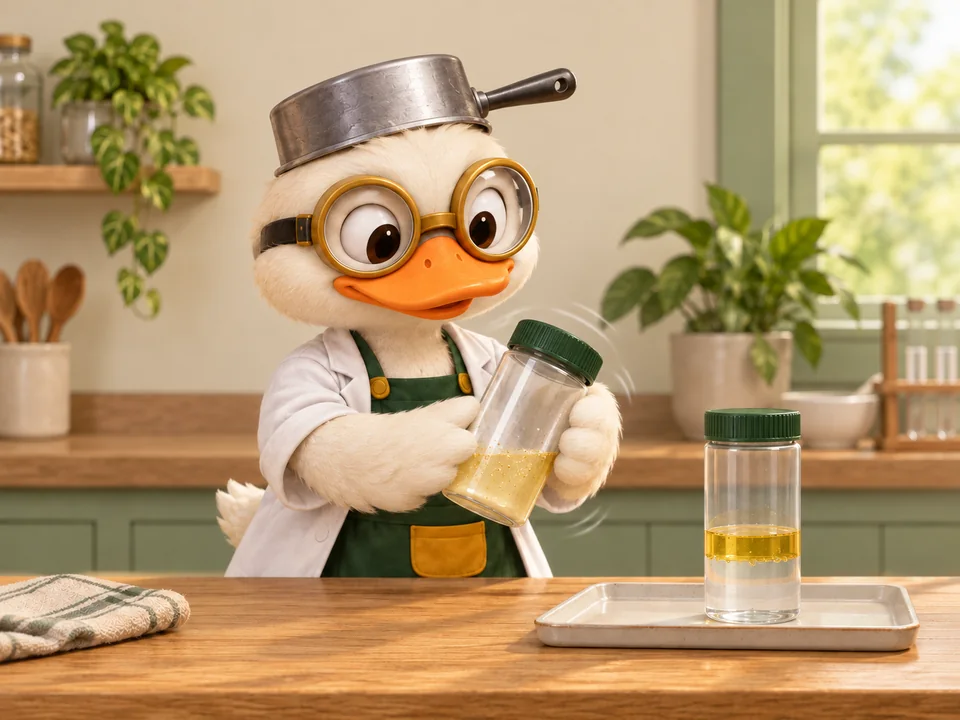 Ingredients
10 min hands-on · Easy
Shake, separate, repeat
Can a good shake make oil and water stay together?
Let’s investigate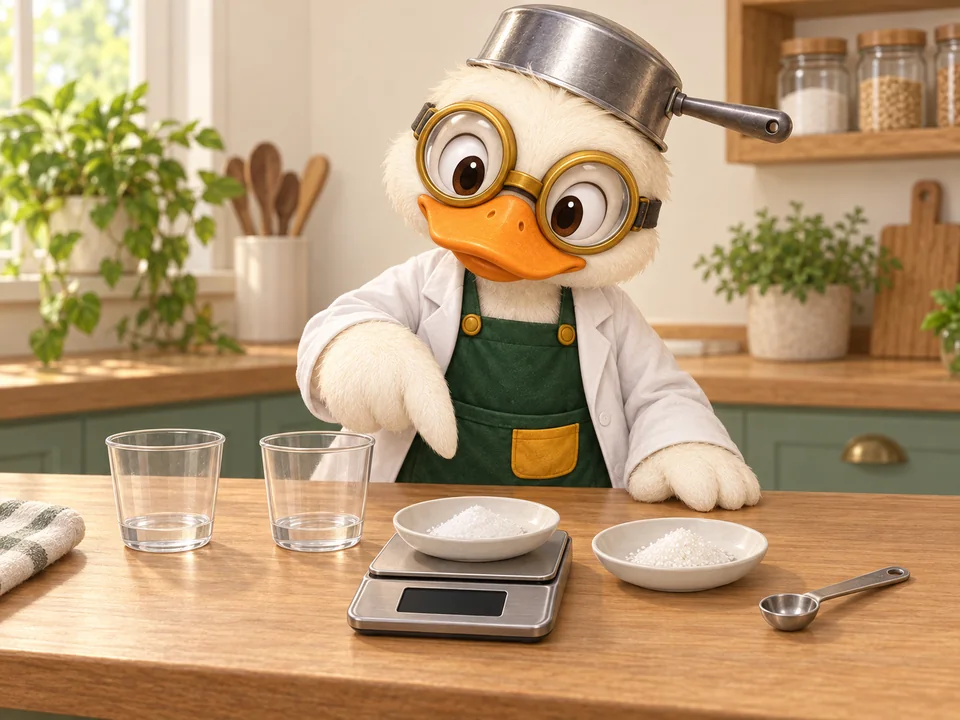 Ingredients
10 min hands-on · A little practice
Where did the crystals go?
Do equal masses of salt and sugar dissolve equally in a little water?
Let’s investigate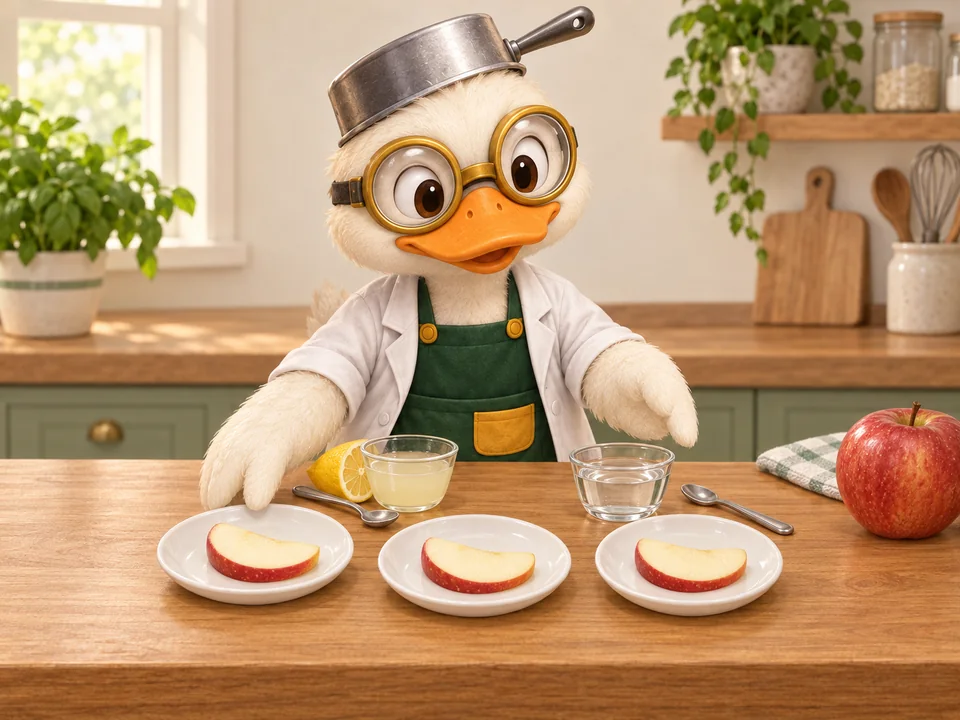 Ingredients
15 min hands-on · Easy
The apple investigation
How do water and lemon juice affect the visible browning of apple slices?
Let’s investigate