Ingredients / Flavor / Kitchen skills
Whole leaf, bruised leaf
What do you notice when matched culinary mint leaves are left whole or gently bruised?
Compare two small pairs of leaves with a spoon and careful observation. Aroma descriptions are optional and personal; drawing or recording is a full part of the investigation.
Proposed procedure; kitchen trial pending. Explore with an adult and follow the preparation and handling notes.
- Hands-on time
- 15 min
- Total time
- About 15 min
- Difficulty
- Easy
- Participation
- Adult setup
Before you investigate
A thoughtful setup.
Keep every investigation sample separate from food to be served. Do not taste these samples.
The adult’s part
- An adult selects labeled culinary mint from a food source, checks participation needs and supplies washed leaves. Do not identify plants by smell.
Tools & heat
- Use the rounded back of a teaspoon to bruise leaves; no knife, grinder or heating equipment is needed.
Ingredients & allergens
- Use only known culinary mint. Do not use wild plants, essential oils, fragrances or cleaning products.
- Rinse fruits and vegetables under running water before cutting or peeling. Do not use soap, detergent or bleach on produce.
- Do not handle or smell mint if it is unsuitable for a participant. A drawing, timing or recording role is a complete way to take part.
- No one is required to smell an ingredient. Stop if the aroma causes discomfort.
Prepare your space
- Scrub hands with soap and running water for at least 20 seconds, including backs, between fingers and under nails. Rinse and dry with a clean towel.
- Keep leaves on their saucers, away from eyes and mouths. Leave space between people and samples.
Build the relevant habits
Review or print my preparation checklist
Checking this browser…
Discover
What you’ll learn.
- Compare matched samples while changing physical treatment.
- Describe appearance and optional aroma separately.
- Recognize that sensory reports vary between people.
Change: Whether two mint leaves remain whole or receive three gentle presses each with a spoon.
Keep the same: Mint variety and bunch · Two similar-sized leaves per saucer · Matching saucers and starting preparation · Viewing conditions and elapsed observation time
My prediction
Try it
Follow your question.
Choose a role and match the leaves
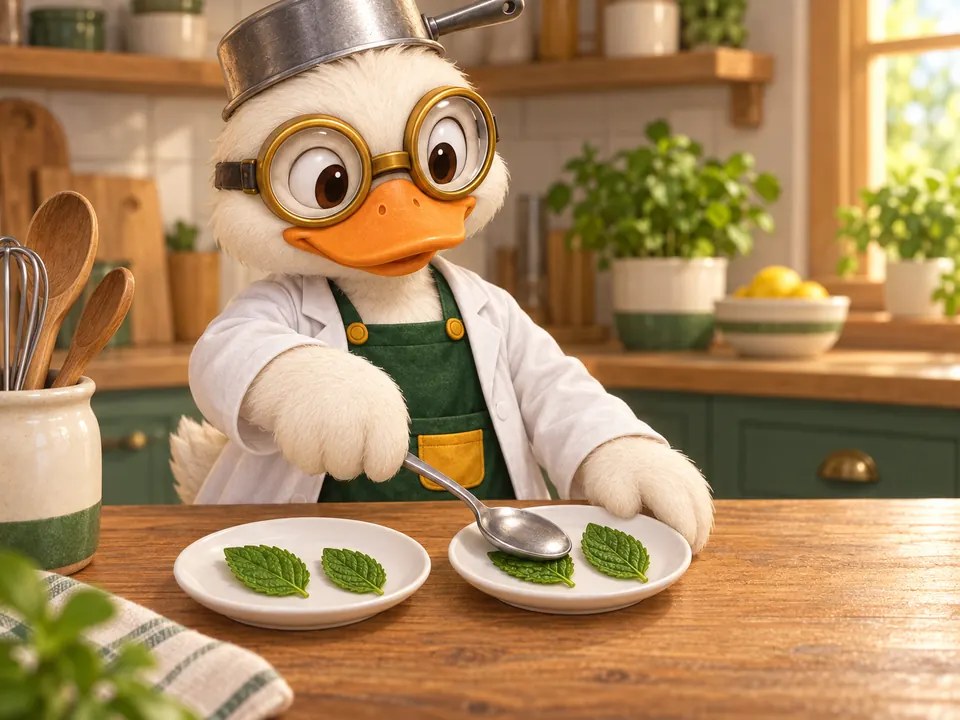
Place two leaves on each saucer. Sketch their initial shapes and color, noting pre-existing tears or marks. Choose your role and record a prediction; a no-smelling role is equally complete.
Care at this step: Adult confirms the plant is culinary mint; learners may select the no-smelling role.
Change one pair
Leave Whole untouched. Use the rounded back of a clean teaspoon to press each leaf on Bruised three times, just enough to crease or bruise it without grinding it into a paste. Record any visible marks, tears or moisture.
Look, and optionally notice aroma
First compare both pairs by sight. Anyone who comfortably chooses to smell can gently waft from a distance, Whole then Bruised, without putting leaves near the face. Pause in ordinary room air between samples. Use personal words such as faint, clear or hard to notice; do not require anyone to agree.
Care at this step: If comfortable, gently waft from a distance; do not press a leaf against the nose or take deep sniffs.
Record whose observation it is
Write or draw the changes you noticed. Mark aroma as not assessed if you skipped it. If recording another person’s words, name the role rather than claiming the perception as your own. An optional intensity scale is 0 not detected, 1 faint, 2 noticeable, 3 strong to me; these numbers are personal ratings, not a chemical measurement.
Consider order and repeat if wanted
For an optional fresh repeat, prepare four new matched leaves and use the same pressing method. A willing observer can examine Bruised before Whole this time. Record this as a second round with a changed order, not as an exact reset of the nose. Otherwise, discuss how order might have influenced the first round.
Explain and clean up
Connect the visible treatment with your own observations, including no detectable difference. Explain why a subjective aroma report cannot measure the amount of a particular compound. Discard handled leaves and clean the saucers, spoon and work area.
Observe
Look a little closer.
- How closely did the two pairs match before pressing?
- What visible changes followed the spoon presses?
- If aroma was assessed, what words did each observer use and in what order?
- Was any result uncertain, unchanged or not assessed?
Different results are useful. Record what you see, rather than trying to match an expected answer.
My observations
Understand
What’s going on?
Aromatic substances in mint can reach the air. Disturbing leaf tissue can help release some of them, which may change what a person notices nearby. The same treatment also changes the leaf’s appearance. Our eyes and optional aroma reports provide observations, but they do not identify or count the compounds released.
Use this in your kitchen
Cooks may gently bruise or cut culinary herbs to change how their aroma is released into a dish. The result depends on the herb and preparation. This activity does not establish the best treatment for every herb or require tasting the leaves.
Go deeper
An aroma is a perception produced when airborne molecules interact with the smell system. Attention, previous exposure, distance and individual sensitivity affect a report. A stronger personal rating is not a calibrated measurement of concentration. Comparing matched leaves helps, but it cannot make two noses identical.
Why results may differ
- Leaf age, size and prior damage may differ.
- Three spoon presses do not measure a fixed force.
- Smell descriptions and ratings are subjective; do not average them into a claimed chemical concentration.
- Order and repeated exposure can affect what a person notices.
Try again
One discovery.
Another question.
Repeat with fresh leaves of the same known mint and reverse observation order, preserving both records. Change to a different culinary herb only as a separately labeled investigation with an adult’s ingredient check.
My conclusion and next question
Finish thoughtfully
Clean up
- Wash saucers and spoon, wipe the surface and wash hands after handling leaves.
Dispose of the samples
- Discard handled leaves after the session; do not return them to the food bunch.
For parents & educators
Learning objectives
- Describe matched samples with concrete words.
- Keep personal perception separate from measured quantities.
- Value visual, timing, drawing and recording participation.
Prepare & make space
Choose identified culinary mint, check suitability and prepare a no-smelling role before introducing the activity. Supply intact matched leaves.
The adult’s part
Select and wash the ingredient, manage participation needs and model gentle handling. Do not turn aroma intensity into a competition.
Talk about it
- Which changes could everyone see?
- Can two different aroma reports both be honest?
- What could a chemical instrument tell us that this activity cannot?
A simple way to join in
Compare appearance only, using a drawing of intact and creased leaves and a spoken explanation.
Take it further
Record observation order and compare a fresh second round. Discuss why reversing order helps examine a possible influence but cannot eliminate every source of variation.
Explore as a group
Offer leaf matcher, spoon operator, illustrator, timer and recorder roles. Aroma observation is always optional and never a condition for completing the activity.
Clean up
Discard handled leaves, wash tools and hands, and wipe the work surface.
Behind the explanation
- Royal Horticultural Society: Guess the herb ↗
Uses disturbed culinary leaves to explore aroma. Our paired whole/bruised comparison omits tasting and blindfolds.
- University of Wisconsin–Madison: Why do flowers smell, and why do plants smell too? ↗
Explains that crushed leaves can release aromatic compounds involved in plant defenses.
- FDA: Selecting and Serving Produce Safely ↗
Supports clean preparation and rinsing produce under running water before cutting, without soap.
Activity exp-herbs · Content version 1 · Sources checked 2026-09-25 · Proposed procedure; kitchen trial pending