A connected kitchen project
Build a better dressing
Can a change in mixing method help a dressing hold together?
Investigate a small batch, compare two mixing methods and write a final formulation with evidence behind your choices.
Proposed procedure; kitchen trial pending. Explore with an adult and follow the preparation and handling notes.
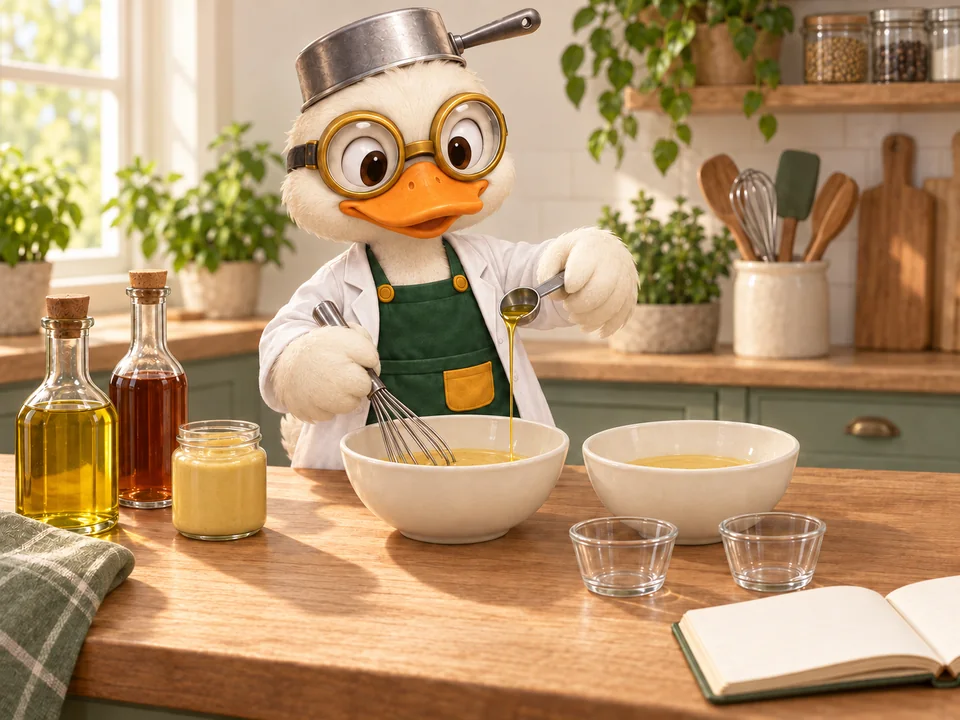
What you’ll make
A documented dressing formula, a comparison of two mixing methods and a reasoned choice for a fresh final batch.
6 stages · 35 minutes hands-on · About 50 minutes total
Before you investigate
A thoughtful setup.
The two comparison samples are observation-only. Optional tasting is limited to the separate fresh final batch at stage 6, made hygienically for immediate adult-supervised use with suitable ingredients and individual clean utensils.
The adult’s part
- An adult reads every ingredient label, confirms the participation plan and supervises the separate observation and optional fresh-food preparations.
- An adult handles knives for any salad vegetables and manages refrigeration and disposal.
Tools & heat
- Use clean food-safe bowls, measuring spoons and whisk or fork. Use separate utensils for tasting.
- There is no heat or raw egg in this project. Keep the knife at the adult preparation station if salad is added.
Ingredients & allergens
- Use the listed vinegar, oil and prepared Dijon mustard, retaining the labels. Do not add raw egg as an emulsifier.
- Rinse any fresh salad produce before cutting. The comparison does not validate preservation, acidity or shelf life. Follow ingredient storage directions and promptly refrigerate any fresh food.
- Contains mustard, which can cause allergy even though it is not one of the nine major U.S. allergens.
- Prepared mustard, vinegar and oil vary by product; read their full labels and advisory information. Check any added salad ingredients and substitutions.
Prepare your space
- Wash hands and prepare a clear stable work area. Label observation cups and place them apart from the final food batch.
- Keep the original packages available and avoid cross-contact between ingredients, utensils and different preparations.
1. Discover the separation problem
Complete Shake, separate, repeat, or review its explanation. Describe the difference between a short-lived cloudy dispersion and visible layers. Write a practical goal for the dressing: for example, remaining evenly dispersed long enough to coat a salad.
Care at this step: Retain all handling guidance if carrying out the linked oil-and-water experiment.
- What does “better” mean for your use?
- What observation could show progress toward that goal?
2. Plan two matching formulations
Label bowls Gradual and All at once. For each trial measure 15 mL vinegar, 5 mL prepared Dijon mustard and 30 mL oil. Use the same brands and starting temperature. Predict which mixing method will give a more uniform appearance. Prepared mustard brings several substances together; this trial compares methods using the same mustard, not pure emulsifier concentration.
Care at this step: Check labels and allergy arrangements before ingredients are measured.
- Which variable will change?
- Which amounts, ingredients and tools will remain alike?
3. Make the gradual-addition trial
Whisk the vinegar and mustard together for 15 seconds. Add the oil in six 5 mL portions during the next 60 seconds while whisking steadily. Continue whisking for 30 seconds. Record the actual timing and any difficulty incorporating oil. Transfer to the labeled clear cup and note the time mixing ends.
Care at this step: Whisk in a stable bowl and keep splashes contained; the sample is for observation.
- How did the appearance change as the oil entered?
- Was the oil fully incorporated before the next addition?
4. Make the all-at-once trial
Using a clean matching bowl and the same type of whisk, combine all three measured ingredients at the start. Whisk for 105 seconds with a similar motion. Transfer to the second clear cup and note the finish time. Observe each sample immediately and at 5 and 10 minutes after its own mixing ends. Equal overall time makes this comparison more useful, though hand-whisking effort cannot be exactly identical.
Care at this step: Use clean equipment for the second trial and wipe oily spills promptly.
- What looks uniform, streaky, thick or layered?
- Are you comparing each sample at the same time since mixing?
5. Compare the evidence
Describe the appearance at each check. If a clear boundary forms, record it; do not force a separation measurement where no boundary is visible. Choose a method based on your observations, or say the trial did not reveal a useful difference. Repeat with fresh ingredients before assuming your result applies generally.
Care at this step: Do not taste either observation sample to choose the more stable mixture.
- Which method better matched your stated goal?
- What could have made the comparison uneven?
- How confident is your conclusion from one pair of samples?
6. Write and make the final formulation
Write a recipe card with the exact ingredients, amounts, chosen method, intended use and storage note. If desired, make a fresh small batch using that card for immediate adult-supervised tasting. Describe flavor and texture separately from your separation evidence. A future trial can change one thing, such as mustard amount, while holding mixing method and the other amounts fixed.
Care at this step: Only this optional fresh preparation is for tasting. An adult prepares produce, checks labels and handling, and provides separate clean tasting utensils. Refrigerate promptly; do not claim a validated storage life.
- What evidence supports your chosen method?
- What would you change next, and what would stay constant?
- Can another cook follow your formulation without guessing?
Finish thoughtfully
Clean up
- Collect oil-containing observation samples before washing. Clean bowls, cups and utensils, wipe greasy surfaces and wash hands.
Dispose of the samples
- Discard the two observation samples under local oily-waste guidance rather than pouring oil down the sink.
- Make only a small fresh final batch for immediate use. An adult manages any remaining food using ingredient storage directions and the applicable cold/time rules; this experiment supplies no new shelf-life claim.
For parents & educators
Learning objectives
- Use an investigation to support a design choice.
- Separate a functional goal, a sensory preference and evidence.
- Document a reproducible formulation.
Prepare & make space
Check allergens and set out labeled portions to reduce measurement errors. Provide clean tasting equipment only if tasting is part of the plan.
The adult’s part
Manage ingredient suitability, knife work and food storage. Help coordinate timing without taking over the observation.
Talk about it
- Can two methods both meet the goal?
- Why record time since mixing rather than just clock time?
- Does changing mustard amount isolate one chemical substance?
A simple way to join in
Measure with help, choose appearance descriptors and dictate a final recipe card. The project is complete without tasting.
Take it further
Repeat the two-method comparison in the opposite order to explore fatigue or practice effects. Keep ingredient quantities fixed.
Explore as a group
Assign matched teams to the two methods, using the same ingredient batches. Compare their actions as well as their samples.
Clean up
Refrigerate any freshly prepared food intended for use, discard repeatedly handled observation material, and wash oily bowls and utensils.
Behind the explanation
- Purdue Extension: Vegetables — Emulsions ↗
The activity compares a mustard dressing made by gradually adding oil while whisking with the same ingredients combined at once, recording appearance and texture.
- American Chemical Society: Can Liquids Dissolve in Water? ↗
Oil and water do not form a lasting solution. Mixing disperses oil temporarily; molecular interactions explain poor solubility, while density explains the order of the layers.
- FDA: Selecting and Serving Produce Safely ↗
Wash hands and equipment, rinse produce under running water before cutting, and keep it separate from raw animal foods. Do not wash produce with soap.
- FDA: Food Safety at Home ↗
Keep perishables refrigerated and limit unrefrigerated time to two hours, or one hour when the surroundings are above 90°F (32°C). Clean hands, tools and work surfaces.
Project project-dressing · Content version 2 · Sources checked 2026-09-25 · Proposed procedure; kitchen trial pending