Ingredients / Texture / Kitchen skills
Shake, separate, repeat
Can a good shake make oil and water stay together?
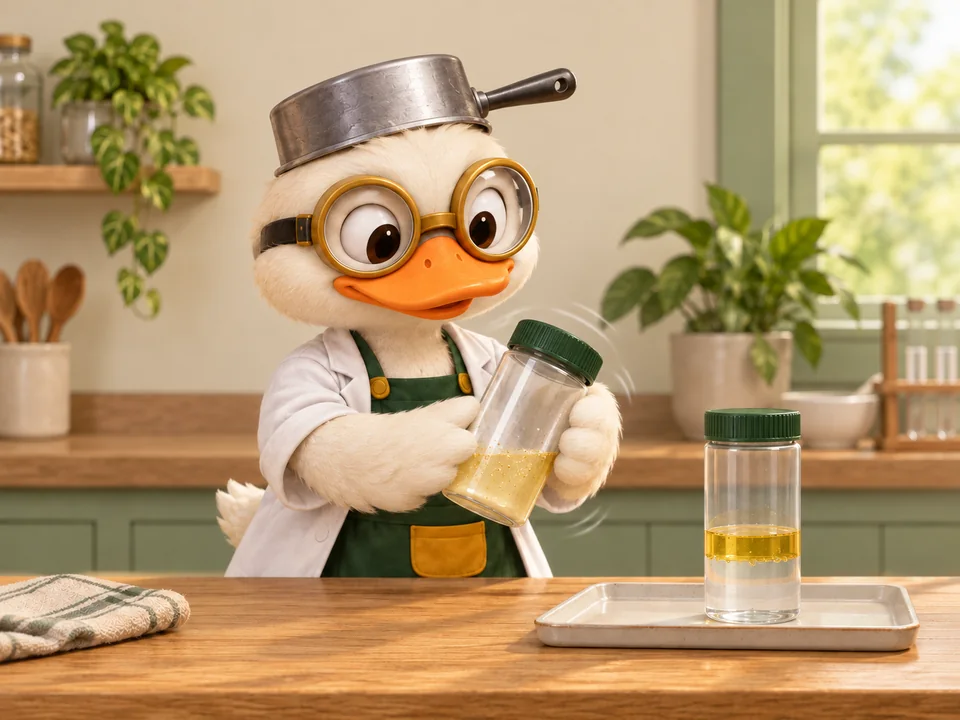
Give one jar a shake and leave its twin alone. Follow tiny droplets as a cloudy mixture changes back into layers.
Proposed procedure; kitchen trial pending. Explore with an adult and follow the preparation and handling notes.
- Hands-on time
- 10 min
- Total time
- About 20 min
- Difficulty
- Easy
- Participation
- Explore together
Before you investigate
A thoughtful setup.
Do not drink either sample or taste liquid from the lid or measuring spoon. Observe layers and droplets through the container.
The adult’s part
- An adult checks both plastic containers and secure lids before any shaking, supervises the motion and manages oily spills and disposal.
Tools & heat
- Use matching food-safe plastic containers that are comfortable to hold; do not substitute glass for the shaking task.
- Use measuring spoons and a tray. No heat or sharp tool is needed.
Ingredients & allergens
- Use identified cooking oil and room-temperature water from the listed recipe. Keep labeled Still and Shaken samples separate from drinks.
- Check the actual cooking-oil label and the participant’s established ingredient restrictions. An oil’s name or clear appearance is not an allergen assessment.
Prepare your space
- Wash hands and use clean equipment. Put both containers on a stable tray away from counter edges.
- Clear space for a gentle shaking motion below face level; stop for any leak.
Build the relevant habits
Review or print my preparation checklist
Checking this browser…
Discover
What you’ll learn.
- Distinguish a temporary mixture from dissolving.
- Describe droplets and layers over time.
- Use an untouched comparison to notice what shaking changes.
Change: Whether the sealed container is shaken for 20 seconds.
Keep the same: Container size and shape · 30 mL water and 15 mL of the same oil in each · Starting temperature · Observation times and background
My prediction
Try it
Follow your question.
Build matching starting conditions
Put 30 mL water into each container, then gently add 15 mL oil. Close both lids. Wait until you can describe the starting layers; record what you actually see.
Care at this step: The adult checks the lid seal before the container leaves the tray.
Change just the mixing
Leave Still on the tray. Shake Shaken back and forth for 20 seconds with its lid secured. Set it beside Still and start your observation clock.
Care at this step: Keep the container below faces and shake only with the lid secured; stop immediately if it leaks.
Look immediately
Compare both containers from the side without moving them. Look for small droplets, larger drops, cloudiness and a boundary between layers. Draw or describe the differences.
Return to the same view
Observe again after 1 minute, then at 5 and 10 minutes after shaking. Keep both containers still between checks. Note when a boundary first becomes visible; it is fine if droplets remain.
Shake, separate, repeat
After the final observation, shake the same Shaken sample for another 20 seconds. Describe what changes again. This repeat shows reversibility; it is not a new controlled trial of a different shaking time.
Care at this step: Check the lid again before repeating the shake. The sample remains observation-only.
Observe
Look a little closer.
- What changed immediately after shaking?
- Where can you see droplets or layers at each check?
- Does the untouched container help explain the change?
- After the second shake, what looks familiar and what differs?
Different results are useful. Record what you see, rather than trying to match an expected answer.
My observations
Understand
What’s going on?
Shaking breaks one liquid into droplets that spread through the other. This temporary dispersion can look like one cloudy liquid, but the oil has not dissolved. Droplets meet and join, and the liquids tend to form separate layers again. Cooking oil usually forms the upper layer because it is less dense than water.
Use this in your kitchen
A simple oil-and-vinegar dressing often needs another shake before serving. Vinegar contains a lot of water, so the same separation problem appears in your salad bowl.
Go deeper
Water molecules interact strongly with other water molecules. Most of cooking oil’s molecular structure is nonpolar, so mixing oil into water is unfavorable. Density affects the vertical order of the layers; it is not the reason the liquids fail to dissolve. A dispersion of droplets of one liquid in another is an emulsion. Ingredients that stabilize droplets can delay separation, which you can investigate in the dressing project.
Why results may differ
- Shaking strength and motion are hard to reproduce exactly.
- Oil type, temperature, droplet size and traces of detergent can affect the appearance and separation.
- Cloudiness alone does not measure droplet size or prove a stable emulsion.
Try again
One discovery.
Another question.
Start with two fresh, matching samples. Change only shaking duration: 5 seconds versus 20 seconds using a similar motion. Compare the appearance at the same elapsed times; do not assume one will remain mixed longer.
My conclusion and next question
Finish thoughtfully
Clean up
- An adult contains and wipes oily spills promptly so the surface and floor are not slippery.
- Wash containers, lids, tray and measuring equipment; clean the workspace and wash hands.
Dispose of the samples
- An adult collects the oily samples for household-waste disposal consistent with local guidance; do not pour oil down a drain. Save the notes instead of the samples.
For parents & educators
Learning objectives
- Make a prediction and revise it using observations.
- Distinguish mixing, dissolving and layering in everyday language.
Prepare & make space
Premeasure the liquids for participants who need that support. Check for detergent residue in washed containers.
The adult’s part
Check lids, supervise shaking and manage oily spills and disposal.
Talk about it
- Can something look mixed without dissolving?
- Why does the Still sample matter?
- What would we need to keep the same to compare two oils?
A simple way to join in
Point to or draw the layers before and after an adult shakes the jar. Choose a description instead of writing.
Take it further
Use a ruler beside the container to record the approximate height of a clearly separated layer. State where you judged its boundary.
Explore as a group
Assign a shaker, timekeeper, observer and recorder. Rotate roles on a fresh trial; compare descriptions before comparing conclusions.
Clean up
Collect the oily samples for adult disposal, then wash containers, tray and hands.
Behind the explanation
- American Chemical Society: Can Liquids Dissolve in Water? ↗
Oil and water do not form a lasting solution. Mixing disperses oil temporarily; molecular interactions explain poor solubility, while density explains the order of the layers.
Activity exp-emulsion · Content version 2 · Sources checked 2026-09-25 · Proposed procedure; kitchen trial pending
Where will your curiosity go next?
 Ingredients
10 min hands-on · A little practice
Where did the crystals go?
Do equal masses of salt and sugar dissolve equally in a little water?
Let’s investigate Texture
20 min hands-on · A little practice
From cream to something new
What changes when you keep shaking cream?
Let’s investigate Ingredients
15 min hands-on · A little practice
Change one thing
Does breaking a sugar cube change what you observe as it dissolves?
Let’s investigate