A connected kitchen project
Build your family kitchen field guide
Which useful habits and real observations belong in a guide you can use again?
Choose relevant lessons and tips, prepare one investigation, and turn your own evidence into a compact printable kitchen reference.
Proposed procedure; kitchen trial pending. Explore with an adult and follow the preparation and handling notes.
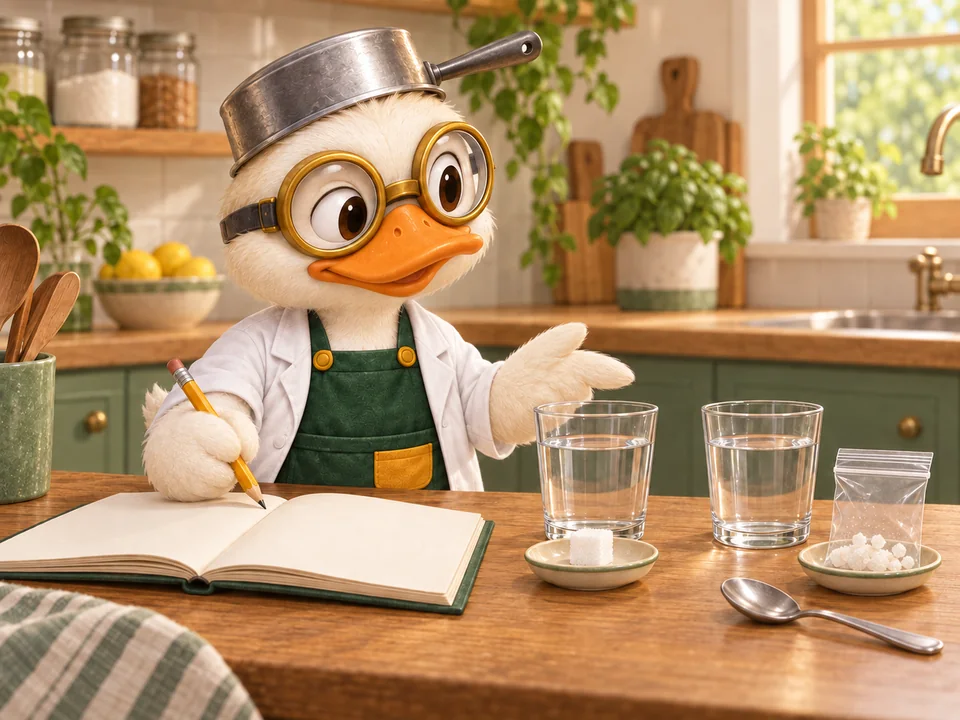
What you’ll make
A printable field guide with a purpose, at least two selected safety lessons, an activity-specific preparation checklist, two useful tips with sources, one real observation with conditions, and a next-time note. No personal names or account are needed.
6 stages · 60 minutes hands-on · About 90 minutes total
Before you investigate
A thoughtful setup.
Guide assembly requires no tasting. If an experiment is added, follow its actual tasting status; the project itself grants no tasting permission.
The adult’s part
- Help select a suitable experiment and review its complete preparation checklist.
- Perform that experiment’s required adult tasks and check the guide before reuse.
Tools & heat
- Writing and printing need no kitchen tools.
- Any investigation uses only the tools and handling specified by its own procedure.
Ingredients & allergens
- No ingredients are required to assemble the guide.
- Use the selected experiment’s actual ingredient list when conducting it.
- Copy relevant ingredient checks from the chosen activity without collecting a health profile.
- Keep ingredient-label and cross-contact limitations with the chosen guidance.
Prepare your space
- Keep paper and devices away from wet samples and active cooking.
- Use a separate clean area to assemble and print the guide.
Build the relevant habits
Make it yours / Private in this browser
Build your field guide.
Your choices and writing stay in your local notebook. No personal names, accounts, or uploads are needed. Export the notebook to keep a backup.
Checking this browser…
QuackPot Food Lab / My local project
Build your family kitchen field guide
Choose an experiment to include its preparation checklist.
My observations
No observations written yet.
Habits to practice
No explanation written yet.
Personal learning notes. These words are the learner’s own record, not a verified result or food-safety certification.
Choose the guide’s job
Pick one practical purpose, such as preparing a first investigation or remembering how to compare mixtures. Give the guide a short title that needs no personal name. Write one question you hope it will help answer. The suggested 60 active minutes cover assembling the guide; add the chosen experiment’s time separately.
- What will this guide help you do?
- What question should it help answer?
- Who will use it: you, a learning partner, or your household? No names are needed.
Select two relevant safety lessons
Read Ready, set, clean and at least one lesson suited to your activity, such as Tools, heat and steam or Ingredients and allergens. Save their titles and links. Write one action from each that you will apply, keeping any rule’s original conditions attached. Use Experiment wisely to confirm the tasting boundary.
Care at this step: Keep source conditions attached to any safety rule.
- Which two lessons did you choose, and where are their source links?
- What concrete action from each belongs before or during your investigation?
- Which task belongs to an adult?
Build the actual preparation checklist
Choose an experiment you can complete with appropriate adult support. Open Set up my lab for that activity and review its work area, materials, ingredient checks, adult jobs, tools, tasting status, cleanup and disposal. Record any missing item and resolve it before starting. Include the activity’s title and checklist in your field guide.
Care at this step: Resolve missing materials or adult support before starting the chosen experiment.
- Which experiment are you preparing?
- What must be ready before the first step?
- What is the sample’s tasting status, and how will cleanup work?
Choose two useful tips
Select two tips from Learn that fit your purpose. Record each title, its practical action, why it applies here and one limit. Keep its source link with the entry so a future reader can check the context. A tip that sounds interesting but does not help this guide can stay saved for later.
- Which two tips will you use?
- When does each apply, and when might it not?
- What source or guide supports each tip?
Add a real observation
Carry out the selected experiment using its full procedure, or use an existing notebook run that you actually completed. Record the date or session label, changed condition, one thing kept the same and one specific observation. Include the original units when there is a measurement. Add a labeled sketch if useful. If you have not tried it, label the section Planned and leave the result blank.
Care at this step: Follow the experiment’s full safety and disposal instructions; record only actual observations.
- What did you actually observe, and under which conditions?
- What did you measure or describe rather than assume?
- What remained unclear or did not go as planned?
Check and print a useful first edition
Read the guide from a future user’s point of view. Check that it contains the selected lessons, actual checklist, two tips, observation and sources. Keep adult tasks and tasting status visible. Add one next-time improvement and print or save the guide locally. Leave unknown results blank and do not claim a safety qualification or kitchen test that never happened.
Care at this step: Printed checkmarks record review, not a safety certification.
- Can another reader tell the difference between a source, your observation and your next plan?
- Are adult jobs, tasting status and cleanup still visible in print?
- What will you improve in the next edition?
Finish thoughtfully
Clean up
- Complete the chosen activity’s cleanup before assembling the final guide.
- Put away paper and tools.
Dispose of the samples
- The selected activity determines sample disposal.
- Guide assembly itself creates no food samples.
For parents & educators
Learning objectives
- Select useful information for a concrete purpose.
- Preserve the conditions attached to safety guidance.
- Connect an actual observation with a reusable checklist and sourced tip.
Prepare & make space
Choose an accessible experiment and allow its separate preparation and observation time. The guide can be assembled in two short sessions; printing is optional.
The adult’s part
Review the selected experiment’s real requirements and supervise its adult tasks. Check the final guide for missing essential instructions before using it in another session.
Talk about it
- What makes a reference useful at the moment you need it?
- Which statement came from a source, and which came from your own investigation?
- What should stay blank until you actually do the activity?
A simple way to join in
Use a one-page guide with dictated sentences and a large sketch. An adult can record links and help choose two lessons and two tips.
Take it further
Make a second edition after another real run. Preserve the earlier observation and explain what changed rather than silently rewriting the result.
Explore as a group
Each group makes a guide for a purpose, without collecting names, health details or contact information. Exchange printed guides locally for readability feedback.
Clean up
Finish the chosen experiment’s disposal and washing first. Then store or print the guide locally and put away learning materials.
Behind the explanation
- FoodSafety.gov: Four Steps to Food Safety ↗
Organizes home food-handling guidance around cleaning, separation, cooking and chilling; the project follows each selected activity’s specific requirements.
- Science Buddies: Variables in Your Science Fair Project ↗
Distinguishes the changed variable, observed response and controlled conditions when planning and interpreting a comparison.
- FDA: Have Food Allergies? Read the Label ↗
Ingredient labels and cross-contact matter; absence of a voluntary precautionary statement is not a guarantee that an allergen is absent.
Project project-field-guide · Content version 1 · Sources checked 2026-09-25 · Proposed procedure; kitchen trial pending