A connected kitchen project
One ingredient, many jobs
How can one familiar ingredient play different roles in two kitchen situations?
Choose an ingredient, follow two supported uses and build a small illustrated explanation. Label what a source tells you, what you predict and what you actually observed.
Proposed procedure; kitchen trial pending. Explore with an adult and follow the preparation and handling notes.
What you’ll make
A printable two-use ingredient report with the ingredient identity and form, two explained roles, a labeled comparison diagram, three words used accurately, source references, an evidence statement and a next question. Optional experiment observations appear only if the investigation was actually completed.
6 stages · 60 minutes hands-on · About 60 minutes total
Before you investigate
A thoughtful setup.
The explanation project needs no tasting. Optional investigations keep their own tasting rules.
The adult’s part
- Help check sources and distinguish a diagram from an instruction to try a new mixture.
- If an optional experiment is chosen, review its complete materials, preparation and safety profile separately.
Tools & heat
- The core project uses a notebook, drawing tools and the lab’s ingredient and word resources. No active appliance is needed.
Ingredients & allergens
- A picture or clean empty package can represent the ingredient; actual food is optional and should remain sealed.
- Do not improvise a tasting or chemical mixture from an ingredient-role diagram.
- If an ingredient is handled for an optional investigation, check its full label and that activity’s allergy guidance. Read ingredient information every time, even for a familiar product. A “Contains” statement identifies major allergens used as ingredients if that statement is present; not every product has one.
Prepare your space
- Keep drawings and devices on a dry table. Separate any investigation samples from food intended for serving.
Build the relevant habits
Build your output / Saved locally
Explain two jobs, with evidence.
Your choices and writing save in this browser's notebook as you edit. Return to this project to resume. No personal names or accounts are needed.
Checking this browser…
01 / Choose an ingredient
Follow one ingredient into two uses
02 / Make the connections
Add the science in your own words
Choose an ingredient to see relevant terms.
Your output will connect the ingredient to both selected uses in an illustrated diagram. The sources describe the science; your own words explain the connection.
03 / Connect an investigation, if useful
Keep observations separate from explanation
Adapt this project for a family or learning group
A younger learner can choose between two prepared options and dictate an explanation while an adult records it. In a group, share reading, calculation or diagram-labeling roles; keep heat, sharp tools and equipment responsibilities with the designated adult.
Compare explanations of the same ingredient. Ask which claim comes from a source and which comes from an actual observation; drawing or dictation can replace extended writing.
QuackPot Food Lab / My local project
One ingredient, many jobs
Ingredient explanation. This diagram describes selected culinary uses; it is not a recipe or a measured experiment result.
Choose an ingredient and two uses to build your diagram.
Actual observations
No observations entered. This space remains open for an actual investigation.
Personal learning record. Selected source explanations and authored planning models are separate from the learner's own notes and observations.
Choose one ingredient and define it
Choose an Ingredient Explorer profile and record the form that matters, such as granulated sugar rather than every sweetener. Write one question about its behavior. Start a report with the ingredient name, profile title and source links. A drawing can represent the ingredient without handling it.
- Which exact ingredient and form are you explaining?
- What do you already think it can do?
- Which of those ideas still needs a source or observation?
Find two supported jobs
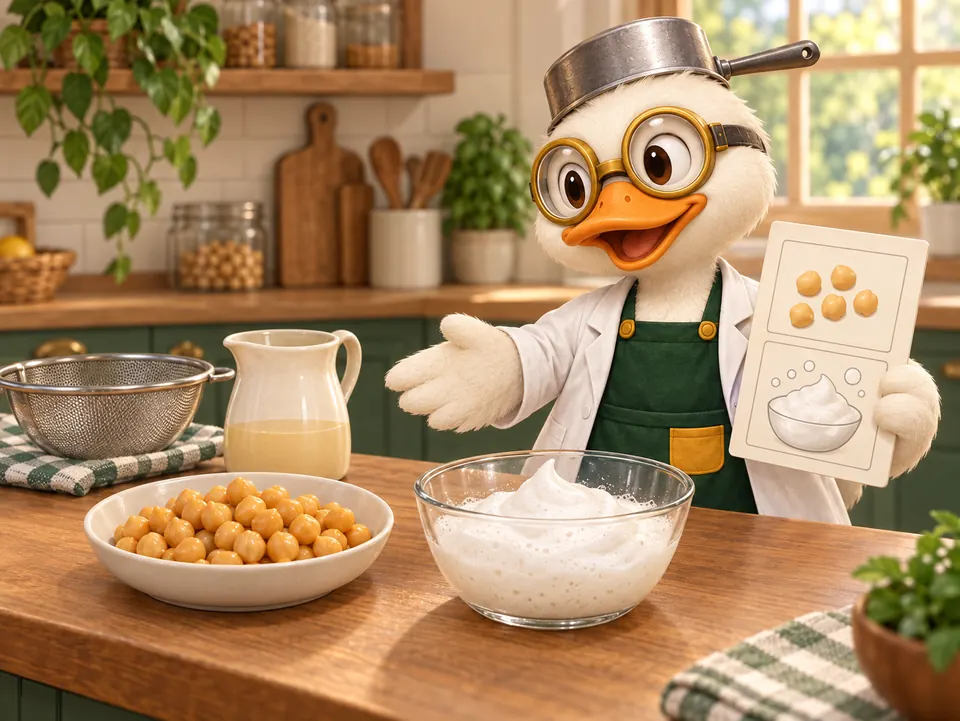
Select two uses supported by the profile and its sources. Sugar can dissolve in water or be used by yeast during gas production. Another example is canned chickpeas: the cooked bean solids provide body in a spread, while the separate can liquid can form a foam. Name these distinct portions; whole beans do not turn directly into foam. Read each supporting source without importing an external recipe as a new activity.
- What role does the ingredient play in situation A?
- What different role does it play in situation B?
- Which source supports each role, and what condition or limitation does it mention?
Build your word kit
Choose three relevant Word Explorer terms. Explain each in your own words, then use it in one sentence about the ingredient. For the sugar example, dissolve, mixture and fermentation can help distinguish the two situations. If a word is unfamiliar, return to the guide before adding it to the report.
- Which three words help explain the difference?
- Can you use each accurately in a sentence?
- Where might an everyday meaning confuse the scientific meaning?
Choose an evidence route
Use a real existing notebook record, run one complete linked investigation with its adult supervision, or finish as a source-based explanation. In the sugar example, the yeast investigation can supply a timed visual observation; the dissolving investigation can supply a description of remaining crystals. Keep predictions separate. If you do not run an activity, write No new investigation performed and leave observation and result fields empty.
Care at this step: Run only a complete linked investigation with its stated adult roles; a predicted result is not an observation.
- Is this statement from a source, a prediction or your own recorded observation?
- If using a notebook result, what was actually measured or seen and under what conditions?
- What does your evidence not establish?
Draw two situations and connect them
Put the same ingredient in the center of a diagram and draw one branch for each use. Add the materials, the relevant action and a short explanation. For sugar, separate dissolving, where intact sugar molecules spread through water, from yeast’s use of sugar in processes that release gas. Arrows express relationships; they do not replace a full safe procedure. Add a source note to each branch.
- What is the ingredient doing in each branch?
- Which change is visible, and which explanation comes from a source?
- Does any picture accidentally imply a guaranteed result or an unsupported substitute?
Teach, revise and finish
Give a short explanation to a partner using the diagram and your three words. Ask the partner to tell the two roles back to you. Correct one confusing sentence, add a limitation and finish with a question you could investigate later. Save and print the complete report with source titles and URLs, diagram description and any genuine notebook observations.
- Could your partner explain both roles without guessing?
- What did you revise?
- What useful next question stays unanswered?
Finish thoughtfully
Clean up
- Save or print the report; put away learning materials. Follow any optional investigation’s cleanup instructions.
Dispose of the samples
- No food waste is required for the core report. Use the optional investigation’s disposal directions if one was run.
For parents & educators
Learning objectives
- Explain two ingredient roles using source-supported conditions.
- Distinguish source claims, predictions and observations.
- Use a diagram and scientific vocabulary to teach an idea.
Prepare & make space
Identify two suitable source-supported uses in a selected profile and offer a paper route. Preselect one optional investigation only if time, materials and adult support permit.
The adult’s part
Help judge the scope of claims and supervise any optional activity separately. Reading a source does not make an improvised kitchen test safe or validated.
Talk about it
- How can the same ingredient participate in different kinds of change?
- What makes a useful diagram different from a list of ingredients?
- Which part of your explanation comes from evidence you collected?
A simple way to join in
Use one provided ingredient profile, two drawings and spoken captions; an adult can transcribe the learner’s words and source references.
Take it further
Compare a second form of the ingredient and explain which claims can and cannot carry over. Do not assume equal-volume substitutions.
Explore as a group
Assign profile reader, source checker, illustrator and explanation tester. Each person identifies one supported claim and one limitation.
Clean up
Save or print the report and put away materials. Complete the separate cleanup procedure for any investigation actually run.
Behind the explanation
- American Chemical Society: Why Does Water Dissolve Sugar? ↗
Explains how sucrose molecules separate into water while remaining intact molecules.
- USDA Agricultural Research Service AgLab: Experimenting With Yeast ↗
Connects yeast’s use of sugar with carbon dioxide production. This project cites the idea and does not import the source’s bread procedure.
- King Arthur Baking: Recipe Success Guide ↗
Ingredient form, measuring method, equipment and technique affect results; changing amounts alone does not review a cooking method.
- King Arthur Baking: A Simple Hummus ↗
Uses cooked canned chickpea solids as the body of a spread. It supports a role example, not a new cooking task in this project.
- University of Minnesota: Evaluation of processing conditions and hydrocolloid addition on aquafaba functionality ↗
The research abstract reports that processing and added hydrocolloids affect aquafaba properties; it does not validate this home procedure.
- King Arthur Baking: A guide to aquafaba ↗
Supports canned-chickpea liquid, electric mixing and the cream-of-tartar ratio. This paired five-minute trial is our proposed adaptation.
Project project-ingredient-jobs · Content version 1 · Sources checked 2026-09-25 · Proposed procedure; kitchen trial pending