Kitchen skill / Static illustrated guide
Choose the mixing movement
Recognize stirring, whisking and folding as purposeful movements. Start with clean empty equipment; no raw food or tasting is needed for this rehearsal.
Step 1
Read the verb and the endpoint
Read both the action and what you should notice. A whisk alone does not specify the endpoint. Find the recipe’s mixing verb and what it asks you to notice: combined, smooth, a named peak or remaining streaks. The tool alone does not tell you the intended motion.
Step 2
Rehearse stirring
Around the lower inside. Rehearse in an empty bowl on a nonslip mat; arrows show motion, not results. Steady the empty bowl. Move the spoon around its inside in a controlled circular path, reaching the lower edge. In a recipe, this movement brings ingredients together.
Step 3
Rehearse whisking
Short, controlled strokes. Rehearse in an empty bowl on a nonslip mat; arrows show motion, not results. Switch to the manual whisk and make short, controlled back-and-forth strokes inside the bowl. Whisking can blend ingredients and, in a suitable mixture, incorporate air.
Step 4
Rehearse folding
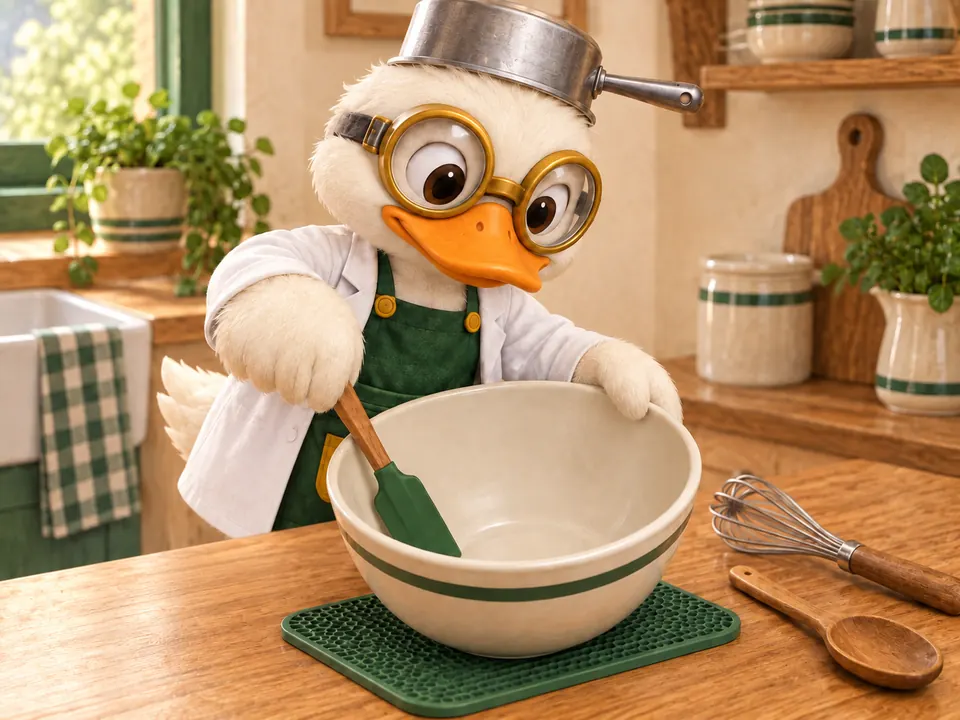
Down, under, then over. Rehearse in an empty bowl on a nonslip mat; arrows show motion, not results. Use the spatula to trace down into the bowl, under the imagined mixture, then lift and turn it over. Rotate the bowl a little and repeat the scoop-and-turn path.
Step 5
Choose for a reason
Explain the chosen motion and follow the recipe’s endpoint. Empty-tool practice needs no raw batter. Point to one mixing direction in your chosen recipe and explain the job it does. During a later adult-supported preparation, follow that recipe’s tool, movement and endpoint.
If it feels tricky.
I keep beating when I mean to fold.
Slow down and trace one down-under-over path in the empty bowl before turning it.
A recipe folds with a whisk instead of a spatula.
Follow that recipe. Folding describes how ingredients are brought together; different tools can perform it in particular mixtures.
A small practice.
Ask a partner to name stir, whisk or fold in a mixed order. Demonstrate each with empty tools and explain one difference in its path. Swap roles. Record the movement that needed another try; no speed or mastery score is required.
Go deeper
A vigorous movement can help incorporate air in one mixture and remove useful air from another. Folding aims to combine while limiting loss of an existing airy structure, but some mixing is still necessary. Follow the evidence and endpoint in the particular recipe rather than a rule that gentler is always better.
Your practice, in your words
What did you try?
“Practiced” records your participation. It does not mean mastery, certification or safety approval.
Checking this browser…
Follow the sources.
- University of Illinois Extension: 4-H Cooking 201, Mixing Terms, pp. 16–17 ↗
- King Arthur Baking: Folding with a Whisk ↗
Content version 1 · Sources checked 2026-09-25 · Published learning resource. Source review is not a physical kitchen trial.