Ingredients / Flavor / Kitchen skills
The apple investigation
How do water and lemon juice affect the visible browning of apple slices?
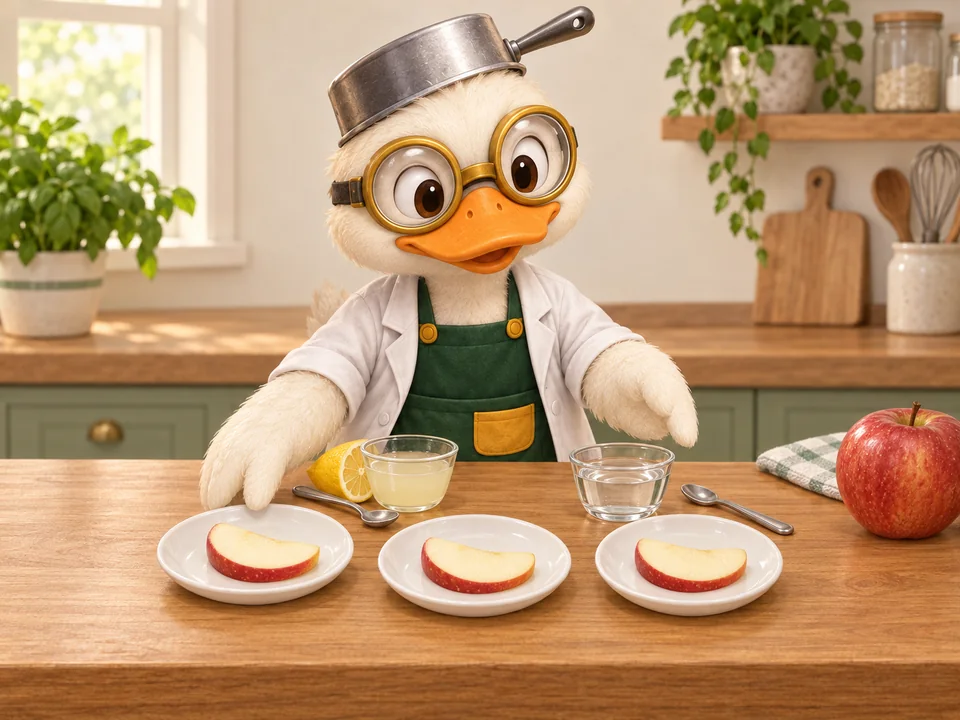
Follow three slices from the same apple for an hour. Treat one, dip one in water and leave one alone to build a useful comparison.
Proposed procedure; kitchen trial pending. Explore with an adult and follow the preparation and handling notes.
- Hands-on time
- 15 min
- Total time
- About 70 min
- Difficulty
- Easy
- Participation
- Adult setup
Before you investigate
A thoughtful setup.
Do not eat any displayed or repeatedly handled apple sample. The comparison concerns browning, not whether food is safe or how long it can be stored.
The adult’s part
- An adult rinses the apple, makes the comparable slices on a stable board and puts the knife away before learners handle plates.
- The adult manages the displayed samples and keeps them separate from food for eating.
Tools & heat
- Knife and cutting board are for adult use. Use separate clean spoons for the lemon and water treatments.
- No heat is needed. Keep fingers clear while the adult cuts.
Ingredients & allergens
- Use a fresh apple, identified lemon juice and water; rinse the apple before cutting without soap. Avoid splashing lemon juice toward skin irritation or eyes.
- Check the actual lemon-juice label and all chosen ingredients against the established participation plan. Apple and citrus can matter even though the U.S. major-allergen list is not exhaustive.
Prepare your space
- Set labeled plates on a stable tray away from snacks. Keep the cutting task separate from the observation station.
- Wash hands and use clean tools; keep produce separate from raw animal ingredients.
Build the relevant habits
Review or print my preparation checklist
Checking this browser…
Discover
What you’ll learn.
- Compare a treatment with both water and an untreated sample.
- Record visible changes at consistent intervals.
- Explain why slowing browning is different from proving food is safe.
Change: Surface treatment: a lemon-juice dip, a water dip or no dip.
Keep the same: Slices from the same apple with similar size and thickness · 30-second dip for both treated slices · Location, lighting and observation times · Exposed cut face placed upward
My prediction
Try it
Follow your question.
Prepare comparable slices
Ask an adult to cut three slices of similar thickness from the same apple. Place one beside each label. Avoid badly bruised sections and record the apple variety if known.
Care at this step: The adult rinses and cuts the apple and removes the knife from the learner’s work area.
Apply the treatments
Use separate clean spoons to dip Lemon in lemon juice and Water in water for 30 seconds each. Leave Untreated undipped. Lift the treated slices out, let excess liquid drip briefly, and place them on their matching plates.
Care at this step: Use a separate spoon for each dip. Avoid splashing lemon juice.
Record the starting appearance
Set all three cut faces upward. Record their appearance and start the observation clock. If you handled them one after another, note that small difference in start time.
Observe the hour
Return every 10 minutes for one hour. Describe the location and extent of visible brown patches. Optional photographs should use the same lighting, angle and background. Leave slices undisturbed between observations.
Care at this step: Keep displayed samples identified and out of reach of anyone who may mistake them for food to eat.
Make a careful conclusion
Compare each treated slice with Untreated and with the other treatment. Name the treatment associated with less visible browning in your samples, or report that the difference was unclear. Include the elapsed time in your conclusion.
Care at this step: Color is evidence about browning only; do not draw a food-safety conclusion.
Observe
Look a little closer.
- What did each slice look like at the start?
- Where did a visible change appear first?
- How did the water dip compare with no dip?
- Did one treatment show less browning at 60 minutes, or was the result unclear?
Different results are useful. Record what you see, rather than trying to match an expected answer.
My observations
Understand
What’s going on?
Cutting damages apple tissue and allows reactions involving oxygen to produce brown-colored compounds. Enzymes help those reactions happen. Lemon juice can slow visible browning through its acidity and other components. Your samples show the effect of the whole lemon-juice treatment, not the isolated action of a single chemical.
Use this in your kitchen
A little lemon juice can help cut apple stay visually appealing, but it also adds tartness. Appearance, flavor and appropriate food storage are separate choices.
Go deeper
An enzyme called polyphenol oxidase participates in apple browning. The rate depends on the apple’s tissues and the surrounding conditions. Acidity can reduce enzyme activity; lemon juice also contains ascorbic acid, which can interfere with oxidation reactions. Because lemon juice changes more than one chemical condition, this comparison cannot tell you which component caused the entire effect. An enzyme is a molecule that helps a reaction proceed; it is not a living organism.
Why results may differ
- Apple variety, ripeness, bruising and slice position can affect browning.
- Lemon-juice composition and uneven coverage can differ between trials.
- Drying and changing lighting can make color judgments difficult.
- One slice per condition is a starting investigation, not enough to establish a general ranking for all apples.
Try again
One discovery.
Another question.
Repeat with three slices per treatment from a fresh apple of the same variety. Keep the treatment and observation schedule unchanged. Compare the variation within each treatment before drawing a stronger conclusion.
My conclusion and next question
Finish thoughtfully
Clean up
- An adult washes the knife and board safely; wash plates and spoons, wipe the tray and wash hands.
Dispose of the samples
- Discard the observation slices after the final record, or compost plant material only where the local program accepts it. Do not save samples for a later tasting.
For parents & educators
Learning objectives
- Use an untreated comparison and a water-treated comparison.
- Describe changes over time without forcing an expected result.
Prepare & make space
An adult sets up the liquid cups and cuts matching slices. Allocate a safe observation spot that can remain undisturbed for an hour.
The adult’s part
Manage all cutting, supervise the liquid dips and keep displayed samples out of snack areas.
Talk about it
- Why compare lemon juice with water as well as with no treatment?
- What changes if the slices come from different apples?
- Does a less brown apple necessarily mean a safer apple?
A simple way to join in
Point to the least-changed slice at each check, draw patches or dictate a description. No tasting is needed.
Take it further
Photograph replicated samples beside the same white card. Create a clearly defined visual scale, while acknowledging that it is a subjective description.
Explore as a group
Use one apple for each group’s full comparison. Compare patterns between groups and note variety or preparation differences.
Clean up
Discard or compost the observation slices as appropriate locally. Wash cups, spoons, plates, board and hands.
Behind the explanation
- American Chemical Society: Slowing Apple Browning ↗
Uniform slices can be dipped for 30 seconds and compared at 10-minute intervals for an hour. The activity connects browning with oxygen, enzymes and treatment conditions.
- University of Maine Cooperative Extension: Fruit Science ↗
Apple browning investigations connect cutting and oxidation with polyphenol oxidase, acidity and ascorbic acid, which is naturally present in lemons and can help prevent browning.
- FDA: Selecting and Serving Produce Safely ↗
Wash hands and equipment, rinse produce under running water before cutting, and keep it separate from raw animal foods. Do not wash produce with soap.
Activity exp-apple · Content version 2 · Sources checked 2026-09-25 · Proposed procedure; kitchen trial pending