Ingredients / Kitchen skills
Where did the crystals go?
Do equal masses of salt and sugar dissolve equally in a little water?
Two white crystals. The same small splash of water. Compare what remains, then discover why dissolved does not mean gone.
Proposed procedure; kitchen trial pending. Explore with an adult and follow the preparation and handling notes.
- Hands-on time
- 10 min
- Total time
- About 10 min
- Difficulty
- A little practice
- Participation
- Adult setup
Before you investigate
A thoughtful setup.
Do not taste dry crystals or drink the solutions. Their identities come from their original labels, not a taste test.
The adult’s part
- An adult confirms ingredient identity from labeled packages, helps use the scale and prevents experimental samples from becoming snacks.
Tools & heat
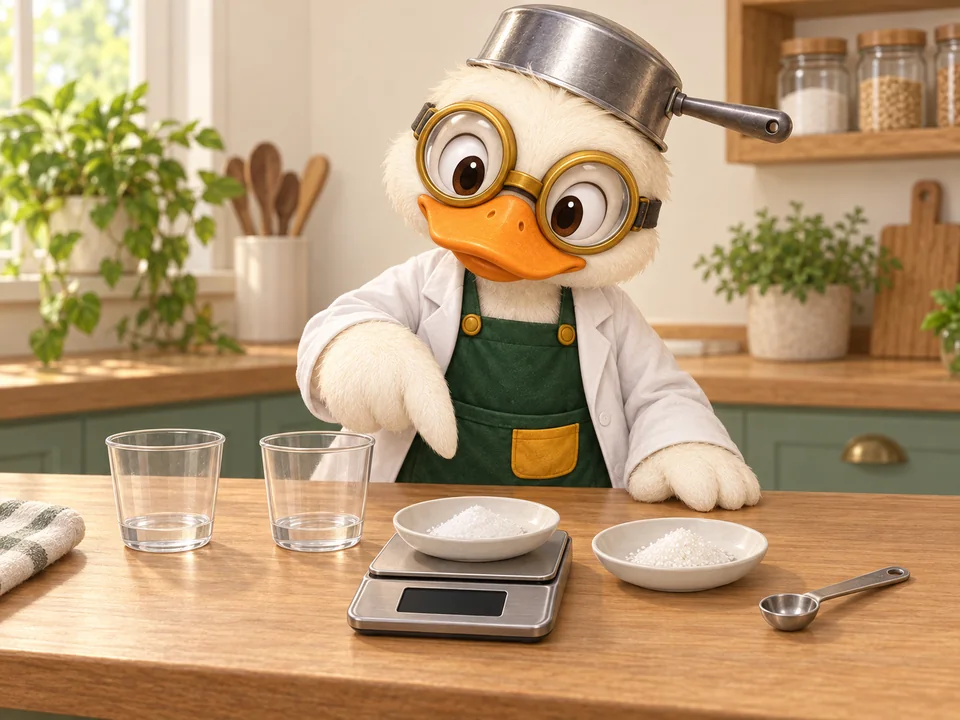
- Use clean dry weighing dishes, matching cups, a scale and a measuring spoon. Keep the scale dry and follow its care instructions. No heat is needed.
Ingredients & allergens
- Use only the listed table salt, granulated sugar and room-temperature water. Do not use unidentified crystals, cleaners or powders.
- Read the actual packages and use clean equipment suited to the established allergy plan. Do not infer suitability from white color or crystal shape.
Prepare your space
- Keep labeled Salt and Sugar cups on a stable, easily cleaned surface. Place the notebook where a splash cannot reach it.
- Wash hands before setup and after cleanup.
Build the relevant habits
Review or print my preparation checklist
Checking this browser…
Discover
What you’ll learn.
- Use equal mass to compare two ingredients.
- Observe dissolved and undissolved material.
- Explain that sugar remains present when its crystals are no longer visible.
Change: The ingredient: table salt or granulated sugar.
Keep the same: 5 g of each ingredient · 5 mL water in each cup · Water temperature and cup shape · Swirling motion and three 20-second mixing intervals
My prediction
Try it
Follow your question.
Look before adding water
Inspect each weighed portion. Record differences in the visible crystals. These descriptions will help distinguish an ingredient’s identity from the way it behaves in water.
Care at this step: The adult checks both labeled ingredients before weighing.
Begin together
With a partner, add the salt and sugar to their labeled water cups at the same time. If working alone, run each sample separately with the same timing and record that choice.
Care at this step: Pour close to the cup to avoid scattering material; do not blow on crystals.
Swirl for the same time
Gently swirl both cups in the same circular motion for 20 seconds, keeping the liquid inside. Stop and compare visible material on the bottoms.
Care at this step: Swirl gently with cups upright enough to keep the liquid inside.
Repeat and observe
Swirl for a second 20 seconds, stop and record. Do this once more for a third 20-second interval. Use the same method for both samples and inspect from the same angle.
Care at this step: Repeat the same gentle motion; stop and clean a spill before continuing.
Compare what remains
After the last interval, describe whether each cup has many crystals, a few crystals or no crystals you can see. If the view is unclear, say so. Do not infer exact grams dissolved from appearance.
Observe
Look a little closer.
- What remained after each mixing interval?
- Which cup had more visible crystals at the end?
- Were the crystals equally easy to see?
- What evidence would help show that the dissolved material is still present?
Different results are useful. Record what you see, rather than trying to match an expected answer.
My observations
Understand
What’s going on?
Dissolving spreads particles from a crystal among the water molecules. The material does not vanish. Under these conditions, sugar can dissolve in a greater amount than table salt, so you may see more salt remaining. A clear-looking liquid can still contain a dissolved ingredient.
Use this in your kitchen
A grainy sauce or drink may still contain crystals. More stirring can help crystals contact water, but it cannot make an unlimited amount dissolve in a fixed amount of water.
Go deeper
Table salt separates into sodium and chloride ions in water. Sugar separates into intact sucrose molecules; the bonds within each molecule remain intact. Solubility describes how much of a substance can dissolve in a given solvent under specified conditions. That is different from dissolving rate, which describes how quickly it happens. This short, visual comparison is not a precise measurement of maximum solubility.
Why results may differ
- A 1 g scale has substantial uncertainty when weighing only 5 g; record the displayed values.
- Grain size, moisture, incomplete transfer and different mixing can alter what remains during a short trial.
- This test compares ingredient identity, which includes multiple molecular differences. It does not isolate grain size.
- No visible crystals is a visual observation, not proof that every particle has dissolved.
Try again
One discovery.
Another question.
Repeat with fresh ingredients and 10 mL water in each cup. Keep each ingredient’s mass, temperature and mixing unchanged. Compare with your first run, explaining that water amount is the changed condition between runs.
My conclusion and next question
Finish thoughtfully
Clean up
- Wipe spills, wash cups, dishes and spoon, clean the workspace and wash hands. Clean the scale according to its instructions without immersing it.
Dispose of the samples
- The small salt and sugar solutions can go into the sink with water where local rules permit. Do not store them as drinks or return wet material to ingredient packages.
For parents & educators
Learning objectives
- Use a controlled comparison with equal masses.
- Separate observations from an explanation about particles.
Prepare & make space
Preweigh labeled samples if scale operation would distract from the investigation. Use identical cups and a shared water source.
The adult’s part
Help with small measurements, check ingredient identity and prevent tasting.
Talk about it
- Why use grams instead of matching spoonfuls?
- Does clear mean empty?
- Is how much dissolves the same question as how quickly it dissolves?
A simple way to join in
Choose between many, a few and no visible crystals while an adult handles measurement and swirling.
Take it further
Repeat the complete comparison three times with fresh samples. Record whether your visual ranking is consistent rather than inventing a mass from the view.
Explore as a group
Pairs handle one cup each. A shared timekeeper calls the starts and stops; groups compare their measurement methods.
Clean up
Pour the small salt and sugar solutions into the sink with water, then wash cups and hands.
Behind the explanation
- American Chemical Society: Using Dissolving to Identify an Unknown ↗
The salt-and-sugar demonstration compares equal 5 g masses in 5 mL water, controlling temperature and mixing, and observes undissolved material over three 20-second intervals.
- American Chemical Society: Why Does Water Dissolve Sugar? ↗
Water attracts polar regions of sucrose molecules, separating molecules from a crystal without breaking the covalent bonds within each sucrose molecule.
Activity exp-crystals · Content version 2 · Sources checked 2026-09-25 · Proposed procedure; kitchen trial pending