A connected kitchen project
Design your own kitchen investigation
How can you turn a kitchen curiosity into a comparison you can explain?
Choose a manageable question, build a fair test, collect real observations and create a short lab report that leaves room for uncertainty.
Proposed procedure; kitchen trial pending. Explore with an adult and follow the preparation and handling notes.
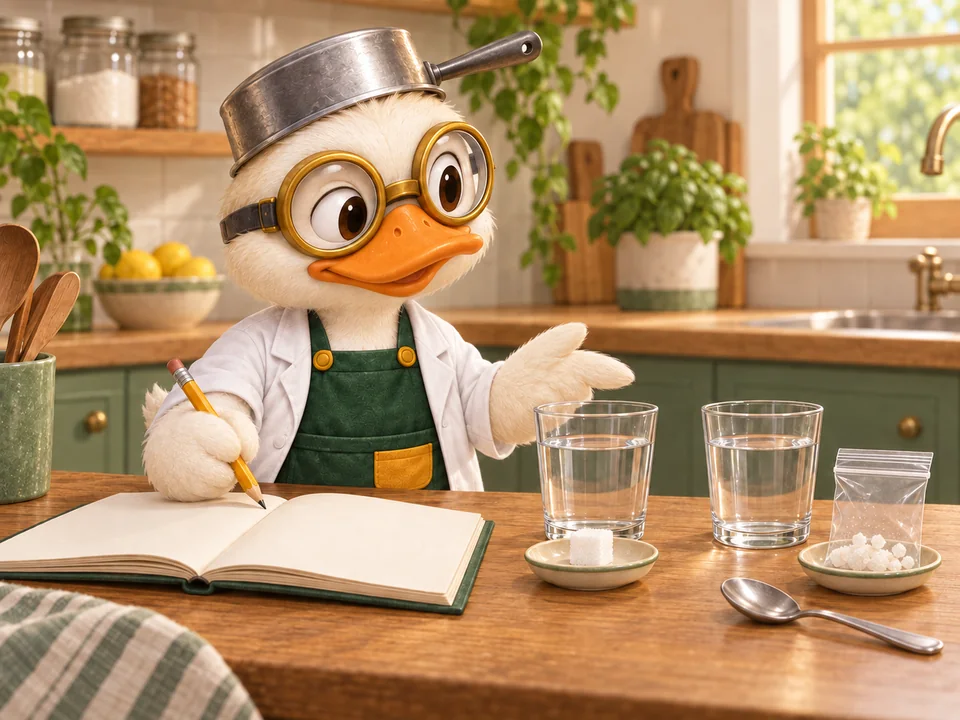
What you’ll make
A one-page investigation plan and a completed report containing the actual conditions, observations, limitations and next question.
6 stages · 40 minutes hands-on · About 60 minutes total
Before you investigate
A thoughtful setup.
Use the suggested no-taste questions. Do not taste experimental or aged samples, and do not use taste to verify a result. A separate food-preparation task requires its own explicitly permitted procedure and adult review.
The adult’s part
- An adult reviews the actual chosen question, material list and numbered procedure before materials are handled.
- Retain the complete safety profile of the linked experiment and review any change. An adult performs all knife work and manages cleanup; the suggested questions need no heat.
Tools & heat
- Use only the tools required by the selected linked activity. Rehearse with empty containers if helpful.
- Do not add heating, pressure, sealed gas-producing vessels or unfamiliar equipment to the plan.
Ingredients & allergens
- Choose an identified low-risk ingredient comparison from the linked activities. Do not use raw animal foods, unknown powders, household cleaners, mold or cultures of unknown microbes.
- Do not use aged food or ask an investigation to determine whether food is safe to eat.
- Carry forward every relevant ingredient and allergen note from the selected activity, including substitutions.
- The adult reviews labels and participation arrangements privately; a report does not need a learner’s medical information.
Prepare your space
- Wash hands, organize a stable work surface and label every sample with its identity and purpose.
- Keep a written plan for stopping, spills and disposal beside the procedure; keep it outside the wet-work tray.
Build the relevant habits
1. Begin with a question you can observe
Choose a question small enough for one comparison. Examples: Does crushing a sugar cube change the visible dissolving sequence? Does shaking duration change oil-water appearance at one minute? Avoid questions such as “Which food is best?” until you define a specific observable feature. The time estimate assumes one short linked activity; apple observations or repeated runs need additional waiting time.
Care at this step: Choose an observable question that fits the linked activity’s safety boundaries.
- What exactly will you observe?
- Can the question be explored without tasting or heat?
- What would count as an unclear result?
2. Name the change and the constants
Write one independent variable: the thing you deliberately change. Write the outcome you will observe and at least three conditions to keep alike. Include quantities, containers, temperature and observation timing when relevant. Use the linked Change one thing activity as a model. Changing “ingredient type” may change several chemical properties together, so describe that limitation honestly.
Care at this step: A changed variable must not introduce heat, unknown materials or a new hazard without a different reviewed activity.
- What is the one planned difference?
- What should stay the same?
- Which conditions can you measure, and which can you only approximate?
3. Predict and prepare
Write a prediction and a reason, or choose “I’m not sure.” Make a labeled materials list and numbered procedure. Decide how and when to record observations before beginning. Ask an adult to check the setup, ingredient labels and handling notes. A quick dry rehearsal with empty containers can reveal missing steps.
Care at this step: The adult reviews materials, labels, tools, tasting status and disposal before starting; use the linked activity’s full profile.
- What do you expect and why?
- What is the comparison sample?
- Where will you record an unexpected result?
4. Run the comparison
Follow the plan, recording actual amounts, start conditions and any departures from the procedure. Write what you see rather than what you expected. If timing matters, note elapsed time for each sample. A spill or missed observation belongs in the record; do not silently replace it with an imagined value.
Care at this step: Stop for spills, damage, discomfort or an unclear next step and record the interruption honestly.
- What happened at each observation point?
- What changed unexpectedly in the setup?
- Did any sample fail to reach the chosen endpoint?
5. Repeat and examine the limits
Where practical, run a fresh comparison using the same plan. Preserve the first run. Compare similarities and differences without averaging descriptions into false numerical precision. If you cannot repeat today, say so and describe what a repeat would help resolve. Do not reuse already changed samples when the starting condition matters.
Care at this step: Use fresh portions for a new run. Do not keep handled or aging samples to force a result.
- Do both runs suggest a similar pattern?
- What might explain a difference?
- Which uncertainty most limits your conclusion?
6. Write a short lab report
Include the question, prediction, changed variable, constants, actual procedure, observations and conclusion. Link a relevant science source, while keeping its explanation separate from your own findings. Use a conclusion such as “In these two trials…” rather than “This always happens.” End with one next question and the single change you would make to investigate it.
Care at this step: Report observations without declaring a food safe or a shelf life established; dispose of samples according to the selected activity.
- What does your evidence support?
- What does it not tell you?
- What is the next fair comparison?
Finish thoughtfully
Clean up
- Follow the linked activity’s actual cleanup procedure, including adult handling of sharp tools or oily waste. Wash hands after cleanup.
Dispose of the samples
- Use the selected activity’s specific disposal method. Save the written report and permitted photographs rather than storing samples.
For parents & educators
Learning objectives
- Convert an open-ended curiosity into a testable question.
- Plan a controlled comparison and record departures from the plan.
- Write conclusions proportional to the evidence.
Prepare & make space
Offer two or three feasible questions and the materials for one. Read the linked activity’s handling notes and allow time for a fresh repeat.
The adult’s part
Review the investigation before materials are handled. Redirect unsafe choices and manage knives, allergens and cleanup.
Talk about it
- Which comparison would answer the question most directly?
- What can an unexpected result teach us?
- How can we describe uncertainty without hiding our observations?
A simple way to join in
Choose between two prepared comparison plans, point to the changed variable and dictate a report using drawings.
Take it further
Define the outcome in more detail, repeat three times and document why some measurements cannot be made precisely with the available tools.
Explore as a group
Assign planning, materials, observation and reporting roles. Have a second group read the plan before starting and ask where an instruction is ambiguous.
Clean up
Follow the linked activity’s disposal instructions, clean the workspace and store the written report with the matching run records.
Behind the explanation
- American Chemical Society: Science Activities ↗
Investigations use controls, change and hold variables, record observations and measurements, and draw conclusions that the evidence supports.
- American Chemical Society: Using Dissolving to Identify an Unknown ↗
The salt-and-sugar demonstration compares equal 5 g masses in 5 mL water, controlling temperature and mixing, and observes undissolved material over three 20-second intervals.
- The Franklin Institute: Surface Area ↗
Dividing the same amount of material into smaller pieces exposes more surface. Its suggested extension compares a whole sugar cube with crushed pieces in water.
Project project-investigation · Content version 2 · Sources checked 2026-09-25 · Proposed procedure; kitchen trial pending