A connected kitchen project
Scale, plan, prepare
How can an ingredient list become a clear, checkable plan for a different number of portions?
Use Recipe Math Lab and Kitchen Timeline to build a preparation plan with quantities, units, equipment, adult roles and ordered jobs. Keep arithmetic distinct from a reviewed cooking method.
Proposed procedure; kitchen trial pending. Explore with an adult and follow the preparation and handling notes.
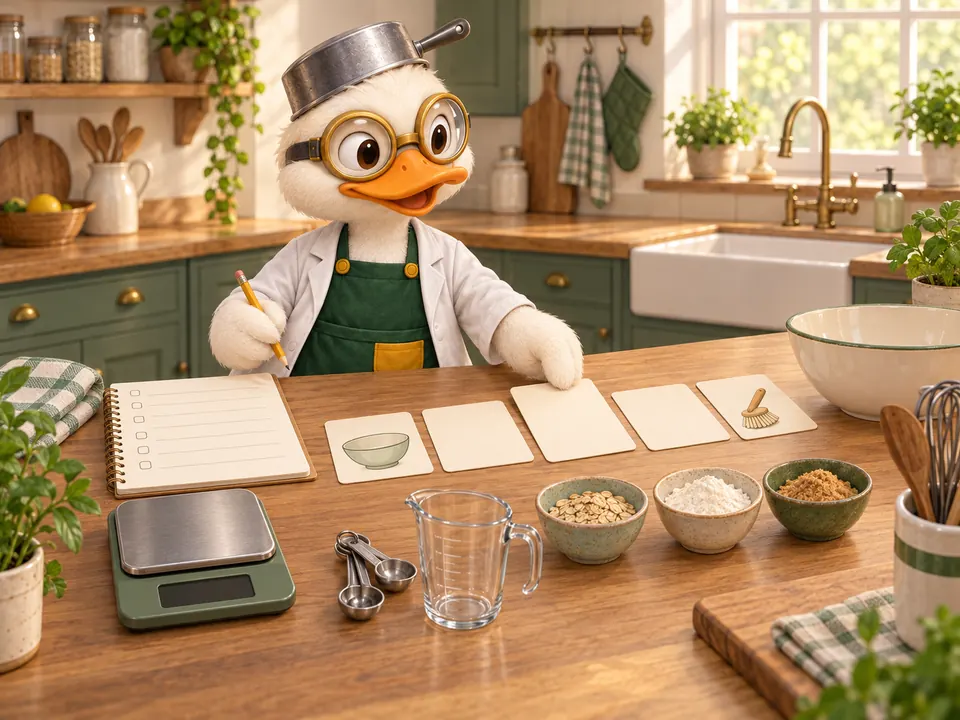
What you’ll make
A printable preparation plan containing the original source and portions, chosen scale factor, original and scaled ingredient table, unresolved measuring questions, equipment and adult roles, and a task timeline with dependencies. It is labeled as a plan requiring adult method review before any cooking.
6 stages · 50 minutes hands-on · About 50 minutes total
Before you investigate
A thoughtful setup.
This is a planning project. It does not direct cooking or tasting.
The adult’s part
- An adult chooses the source recipe or practice list and reviews every tool, ingredient and proposed adult-only job.
- Any later cooking requires a separate review of the original method, equipment, storage and applicable food-safety rules.
Tools & heat
- Use paper or the planning tools. Tools shown on the plan need not be switched on or handled.
Ingredients & allergens
- No food handling is needed. Preserve each ingredient’s name, form, units and source wording in the plan.
- Include a label-check task when the real ingredients are chosen. A calculated list does not approve a substitution for allergy safety. Read ingredient information every time, even for a familiar product. A “Contains” statement identifies major allergens used as ingredients if that statement is present; not every product has one.
Prepare your space
- Use a dry table for the notebook and device. Keep inactive kitchen tools out of reach unless an adult is demonstrating one.
Build the relevant habits
Build your output / Saved locally
Turn a calculation into a plan.
Your choices and writing save in this browser's notebook as you edit. Return to this project to resume. No personal names or accounts are needed.
Checking this browser…
01 / Choose and scale
Start with an ingredient list
Examples are arithmetic exercises. For actual cooking, use a reviewed recipe and record its reference below.
Import a saved calculation (0)
No saved calculations yet. Create and save a calculation in Recipe Math Lab.
Edit a custom ingredient list in Recipe Math Lab →
Servings: 2 → 4. Factor: 2×.
Desired ÷ original servings. Multiply each original amount by that factor. No unit conversions occur.
| Ingredient | Original | Scaled |
|---|---|---|
| Cooked chickpeas | 240 g | 480 g |
| Lemon | 1 count | 2 count |
| Cooking oil | 1 1/2 US tbsp | 3 US tbsp |
| Seasoning | to taste | to taste |
Displayed amounts are rounded to at most three decimals; very small amounts use three significant figures. “To taste” and “as needed” remain instructions.
02 / People and equipment
Make responsibilities visible
03 / Arrange a timeline
Check what must happen first
Import a saved timeline (0)
No saved timelines yet. You can arrange one here or use the Timeline Challenge.
Get matched samples ready, make an observation, and leave the work area ready for the next person.
Move tasks with the buttons, then adjust start minutes to explore parallel work. Moving a task resets starts to a sequence. A waiting task does not occupy a person's active attention.
- Record what you noticed
Describe the actual comparison without treating an impression as a measurement.
learner · Active · 3 min estimate
Needs: Observe the comparison
- Clean hands and workspace
Learner prepares a clean work area with adult support.
learner · Active · 3 min estimate
Needs: No previous task
- Make two sample labels
Adult writes Whole and Bruised on paper beside the dishes.
adult · Active · 2 min estimate
Needs: No previous task
- Prepare matched herb samples
Use the full experiment for the matched portions and gentle spoon action.
learner · Active · 4 min estimate
Needs: Clean hands and workspace; Make two sample labels
- Observe the comparison
This observation needs its samples prepared first. Smelling is optional.
learner · Active · 2 min estimate
Needs: Prepare matched herb samples
- Discard samples and clean tools
Keep observation samples separate from food intended for eating.
learner · Active · 4 min estimate
Needs: Record what you noticed
- Record what you noticed needs “Observe the comparison” finished first.
Adapt this project for a family or learning group
A younger learner can choose between two prepared options and dictate an explanation while an adult records it. In a group, share reading, calculation or diagram-labeling roles; keep heat, sharp tools and equipment responsibilities with the designated adult.
An educator can ask two groups to create different valid orders and explain the dependencies. Compare the plans without treating estimated minutes as a cooking instruction.
QuackPot Food Lab / My local project
Scale, plan, prepare
Planning sheet. Ingredient arithmetic and estimated task times do not validate a recipe or establish that food is safe.
Servings: 2 → 4. Factor: 2×.
Desired ÷ original servings. Multiply each original amount by that factor. No unit conversions occur.
| Ingredient | Original | Scaled |
|---|---|---|
| Cooked chickpeas | 240 g | 480 g |
| Lemon | 1 count | 2 count |
| Cooking oil | 1 1/2 US tbsp | 3 US tbsp |
| Seasoning | to taste | to taste |
Displayed amounts are rounded to at most three decimals; very small amounts use three significant figures. “To taste” and “as needed” remain instructions.
Reviewed procedure
No reviewed procedure recorded. This remains an arithmetic and planning exercise.
Tools and workspace
Not listed yet.
Adult responsibilities
Not assigned yet.
How the scenario fits this plan
Connection and any recipe-specific changes not described yet.
Planning timeline: A no-heat herb observation
Get matched samples ready, make an observation, and leave the work area ready for the next person.
- Minute 0–3 · Record what you noticed
Describe the actual comparison without treating an impression as a measurement.
Assigned to learner · 3 min estimate
- Minute 3–6 · Clean hands and workspace
Learner prepares a clean work area with adult support.
Assigned to learner · 3 min estimate
- Minute 6–8 · Make two sample labels
Adult writes Whole and Bruised on paper beside the dishes.
Assigned to adult · 2 min estimate
- Minute 8–12 · Prepare matched herb samples
Use the full experiment for the matched portions and gentle spoon action.
Assigned to learner · 4 min estimate
- Minute 12–14 · Observe the comparison
This observation needs its samples prepared first. Smelling is optional.
Assigned to learner · 2 min estimate
- Minute 14–18 · Discard samples and clean tools
Keep observation samples separate from food intended for eating.
Assigned to learner · 4 min estimate
- Record what you noticed needs “Observe the comparison” finished first.
Handling constraints
- Scrub hands with soap and running water for at least 20 seconds, including backs, between fingers and under nails. Rinse and dry with a clean towel.
- Rinse culinary herbs under running water; do not use soap on produce. Participation in smelling is optional. Record appearance instead if preferred.
- This is an observation-only planning exercise. Follow the full herb experiment before handling samples.
Minutes are planning estimates. Check actual food, equipment and the reviewed procedure when preparing.
Timeline handling sources
- FDA — selecting and serving produce safelyhttps://www.fda.gov/food/buy-store-serve-safe-food/selecting-and-serving-produce-safely
- FoodSafety.gov — clean, separate, cook, chillhttps://www.foodsafety.gov/keep-food-safe/4-steps-to-food-safety
Personal learning record. Selected source explanations and authored planning models are separate from the learner's own notes and observations.
Choose and identify the starting list
Select a complete source with an adult. Copy its title, URL or book/page reference, original yield and ingredient forms. A list alone may be used for arithmetic practice, but mark its method as missing. State the people or portions you are planning for without entering anyone’s personal details.
Care at this step: Identify the source and mark this as a plan before entering ingredients.
- What is the source and its original number of portions?
- Does it include a complete method, or is this an arithmetic-only list?
- Which ingredient words, such as packed, drained or chopped, must remain attached to the amounts?
Calculate and keep the working
Enter original and target portions in Recipe Math Lab. For each ingredient, record original amount, unit, scale factor and proposed scaled amount. Keep mass and volume distinct. Example arithmetic only: a factor of 1.5 changes 200 g to 300 g; it does not tell you how to cook that new batch. Do not round an awkward amount silently.
- What is target portions divided by original portions?
- Can you reproduce one result with a written multiplication?
- Which results need a practical measuring decision, and who will review it?
Check ingredients and equipment
Compare the table with the original line by line. Preserve ingredient names and forms; mark package size, allergy checks, substitutions and incomplete units as open questions. List suitable bowls, measures, pans and storage containers. A bigger quantity may need a different method or several batches, so record the capacity issue without inventing a solution.
- Are any amounts missing units or using an unclear cup size?
- Will the proposed quantity fit the specified equipment?
- Which label or substitution questions remain unresolved?
Assign roles and review the method
List each job and mark adult-only tasks such as cutting, heating and electrical equipment. Ask the adult to review the original method alongside the changed quantities. Keep temperature, safe handling, doneness checks and cooling requirements attached to that method; the calculator does not establish them. Unresolved items remain visible on the plan.
Care at this step: Adult approval applies to a later cooking method, not merely to correct arithmetic.
- Which tasks require an adult?
- What must be checked before this plan could become cooking instructions?
- Which steps cannot be approved from arithmetic alone?
Arrange the work in time
Add tasks to Kitchen Timeline with planned durations, dependencies and roles. Show what must finish before the next job begins, such as making refrigerator space before preparing a chilled item. Include setup and cleanup. Durations are planning estimates; do not transform them into claims of food safety or proof of doneness.
- Which jobs can happen together with enough safe supervision?
- Which job blocks the next one?
- Where are cleanup, waiting and adult review shown?
Teach the plan and print it
Read the plan to a partner who checks one scaled line and follows the task order. Record a correction or an unresolved question. Save and print the table, source, assumptions, adult roles and timeline together. Mark it Planned — method review required; if no cooking took place, leave all outcome and observation fields blank.
- Can a reader trace one amount back to its source?
- What changed after the check?
- What remains to be reviewed before cooking, and what evidence shows this is a plan?
Finish thoughtfully
Clean up
- Save or print the plan. Put away paper and any demonstration tools.
Dispose of the samples
- No ingredients need to be discarded; the core project uses no food.
For parents & educators
Learning objectives
- Apply a portion ratio while preserving units and ingredient form.
- Make task dependencies and adult roles explicit.
- Distinguish planning estimates from validated cooking and safety instructions.
Prepare & make space
Choose a short complete recipe or a clearly marked practice list. Identify difficult quantities in advance without resolving them for the learner. Provide a source citation.
The adult’s part
Review the selected material and role assignments. Any later cooking needs a separate method and equipment review; correct arithmetic alone is insufficient.
Talk about it
- Which parts of a recipe are numbers that scale directly?
- Why might two half-size batches differ from one double-size batch?
- What does a useful unresolved-question list prevent?
A simple way to join in
Use a factor of two with three ingredients and a paper sequence of four preparation jobs.
Take it further
Compare two possible target yields. Identify which produces more practical quantities without claiming it is the better cooking method.
Explore as a group
Assign source reader, calculator, unit checker and timeline checker; rotate and have one learner independently reproduce an amount.
Clean up
Save or print the completed plan, close unused tool drafts and put away demonstration measures.
Behind the explanation
- King Arthur Baking: Recipe Success Guide ↗
Ingredient form, measuring method, equipment and technique affect results; changing amounts alone does not review a cooking method.
- Utah State University Extension: Healthy Snacks curriculum — Measuring ↗
Explains spooning, packing brown sugar and leveling dry measures; the matched repeated comparison here is an adaptation.
- King Arthur Baking: Why a digital kitchen scale is a baker’s best friend ↗
Explains weighing in grams and subtracting the container with tare.
- FDA: Have Food Allergies? Read the Label ↗
Supports checking complete ingredient labels and considering cross-contact.
Project project-scale-plan · Content version 1 · Sources checked 2026-09-25 · Proposed procedure; kitchen trial pending