Kitchen skill / Static illustrated guide
Make observations you can use
Create a record that another person can understand without guessing what you changed or what you actually saw. Use the linked oil-and-water investigation or review an existing saved run.
Step 1
Write a question before a result
A question, a prediction and an observation have different jobs. Keep them in separate spaces. Copy the question and name the difference you intend to compare. Write your prediction separately so you can revisit it even if the result surprises you.
Step 2
Name what stays comparable
Name the one planned change and the conditions you will keep comparable. Record any mismatch. List important constants such as ingredient amounts, containers, viewing position and observation times. If something differs, record it rather than pretending the conditions were identical.
Step 3
Prepare blank spaces
Prepare the table now. Fill rows only with observations or measurements you actually make. Make columns for sample label, time, what you notice and any actual measurement with its unit. Leave all result cells empty until you observe.
Step 4
Look from the same position
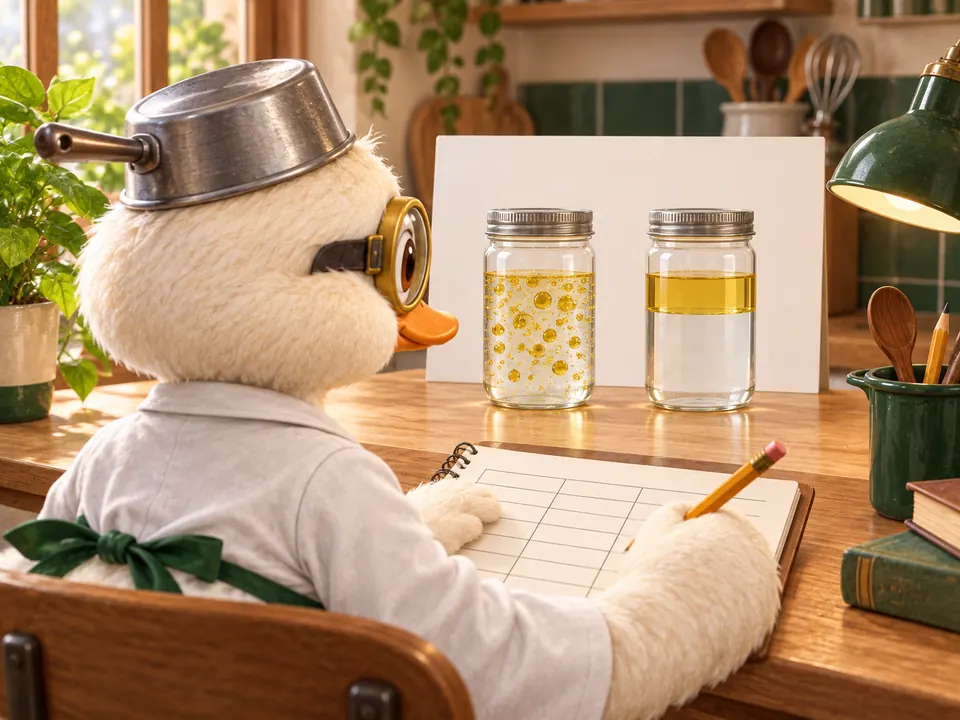
Same background, height and elapsed time. Keep lids secured and describe what you actually see. For the linked sealed oil-and-water comparison, use the same background and viewing height for each container. Describe layers, droplets and boundaries without opening the samples.
Step 5
Describe first, explain second
Describe first, then tie an explanation to that evidence. Uncertain or unchanged observations are valid notes. Write what was visible, including no clear change or an uncertain boundary. Then add a separate possible explanation and identify what evidence supports it.
Step 6
Plan a useful repeat
Keep the first record. Use a limitation to plan a new run, after the original activity’s cleanup. Name one limitation and a repeat that could address it. Keep the first record; create a new run for the repeat so earlier observations are not overwritten.
If it feels tricky.
I wrote “it worked.”
Replace it with a visible feature and its context: which sample, when, and what changed or stayed the same.
My result does not match my prediction.
Keep both. Check labels, conditions and possible alternative explanations before deciding what the comparison supports.
A small practice.
Open a completed local run or follow the linked investigation with its adult setup. Underline one observation and circle one explanation. Add a missing label, unit, time or limitation without altering the recorded result. If you have no run, prepare only the blank table.
Go deeper
A comparison can support a claim without proving every part of an explanation. Repeated observations show whether a pattern recurs; an unchanged outcome may reflect a small effect, an insensitive measurement or the conditions chosen. Honest uncertainty gives the next investigation a better starting point.
Your practice, in your words
What did you try?
“Practiced” records your participation. It does not mean mastery, certification or safety approval.
Checking this browser…
Follow the sources.
Content version 1 · Sources checked 2026-09-25 · Published learning resource. Source review is not a physical kitchen trial.